
Simple yard design in 2027 is about working with what you have, not adding more. This collection of 29 outdoor spaces proves that a thoughtful path, a few boulders, or a single pergola can transform a backyard into a place you actually want to spend time. If you are tired of complicated landscaping plans that demand constant upkeep, these ideas show you how to get a clean look with less effort.
Each photo focuses on a real yard, using materials like gravel, stone, and concrete in ways that are easy to copy. You will see how to turn a plain plot into something that feels intentional without needing a designer or a big budget.
Charming cottage garden backyard with rose-covered pergola
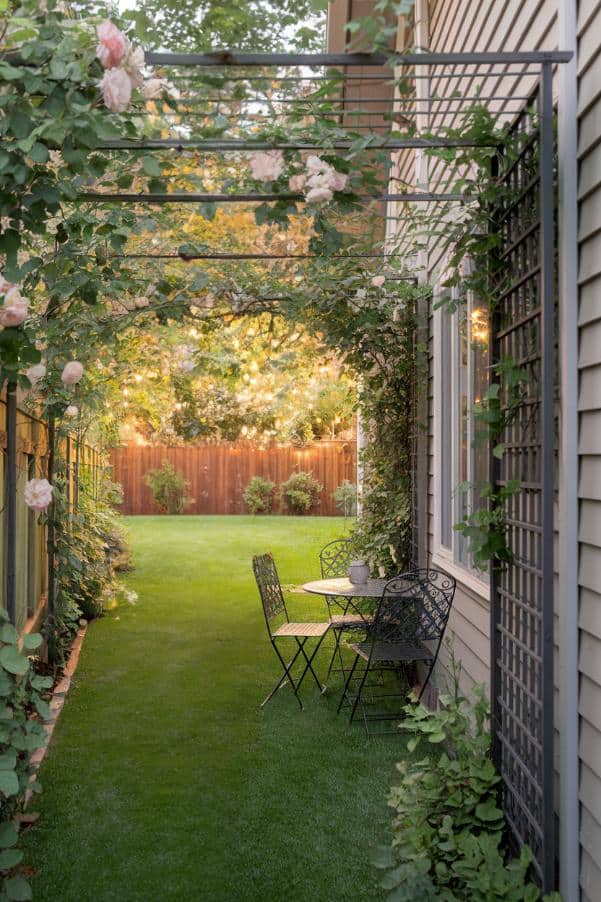
A rose-covered metal pergola anchors this compact backyard, its green and pink blooms drawing the eye upward while the seating area stays tucked near the house. The layout works like a simple equation: a pathway leads from the patio to the lawn, and the pergola sits at the edge, not the center. That placement keeps the space from feeling crowded. A metal bistro set under the structure offers a spot to sit without blocking the view across the yard. The evening sun filters through the roses, softening the wood tones and stone underfoot.
Elegant cottage backyard with white gravel and stone path
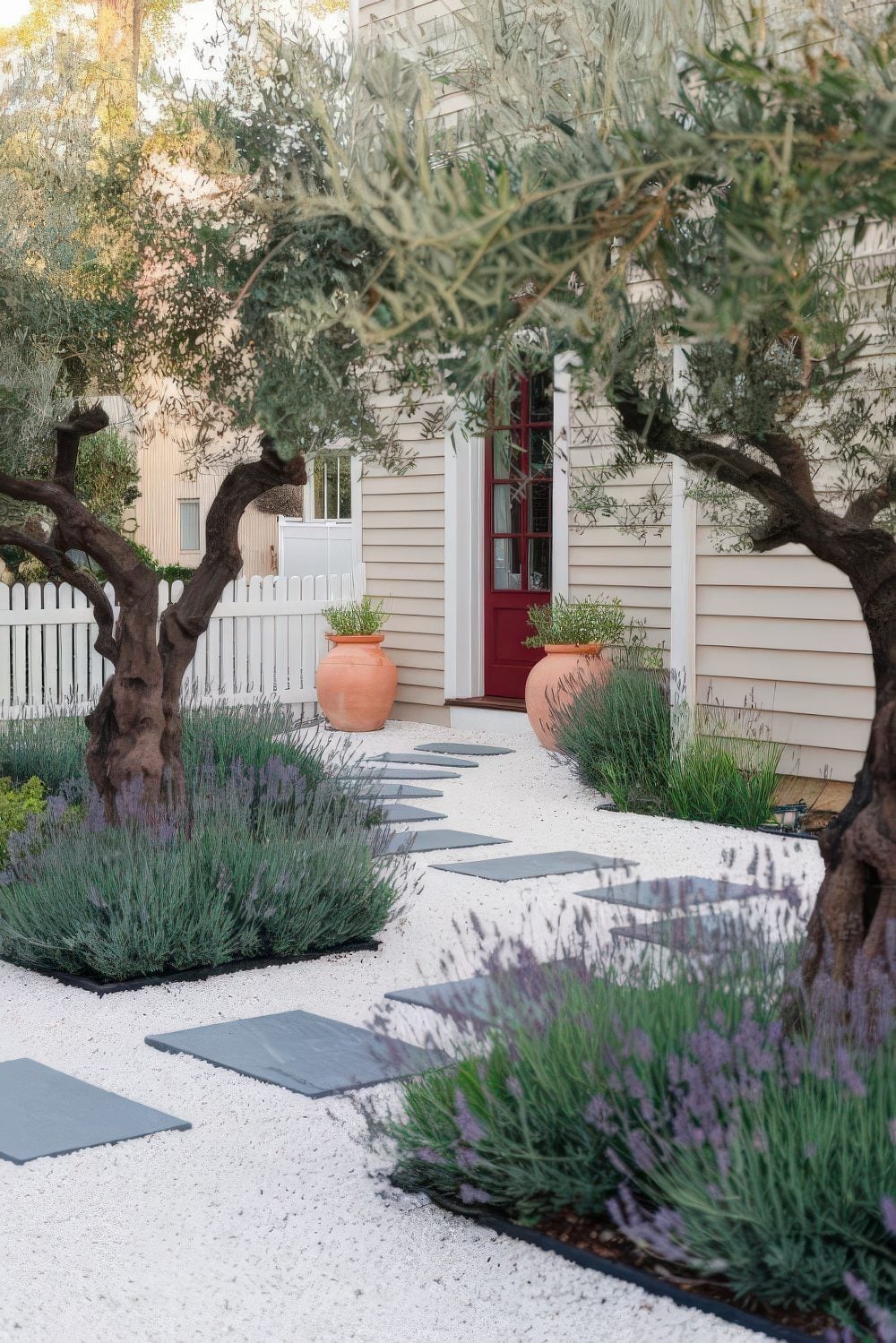
White gravel and stone pavers create a winding path that looks intentional without being rigid. The palette sticks to tan, red, green, and purple, with terracotta pots and lavender plants adding contrast against the pale ground. Olive trees flank the path, their silvery leaves breaking up the warm tones. A picket fence at the back sets a clear boundary, but the open layout keeps the yard feeling larger than it is. The materials here do the work: stone for durability, gravel for drainage, and wood for warmth. The path guides movement naturally, so the garden beds feel discovered rather than staged.
Modern backyard featuring a shipping container structure
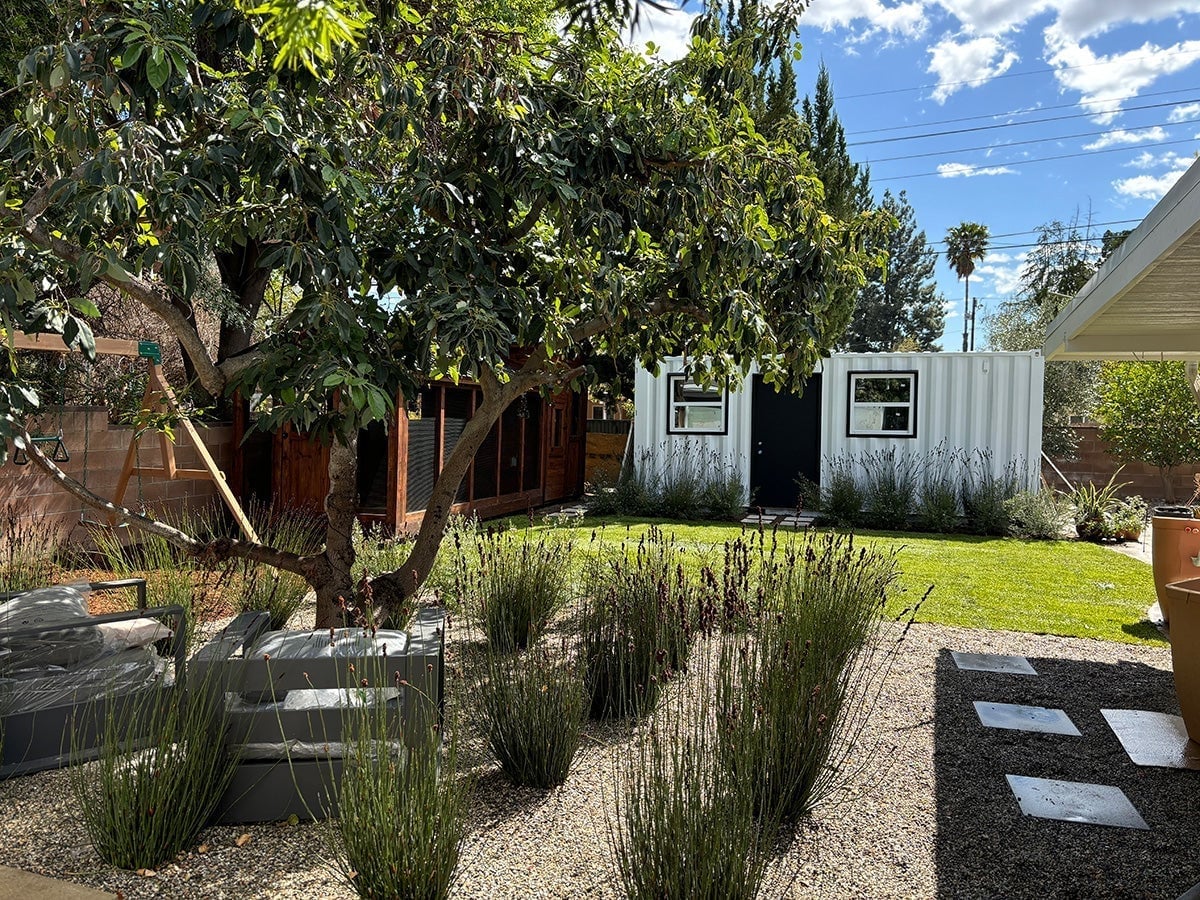
Can a shipping container look intentional in a backyard? This one does. The white corrugated metal structure sits beside a wooden shed, and the contrast between industrial and natural materials defines the whole space. Gravel beds and ornamental grasses soften the hard lines, while a stone path connects the lawn to the planted beds. The style is modern but not cold. The palette stays in whites, blacks, greens, and browns, with the metal acting as the anchor and the wood and stone providing texture. What breaks the look is the gravel. It adds a loose, organic feel that keeps the container from looking a storage unit. Overhead clouds filter the daylight, so nothing casts a harsh shadow.
Traditional front yard with tiered flower beds
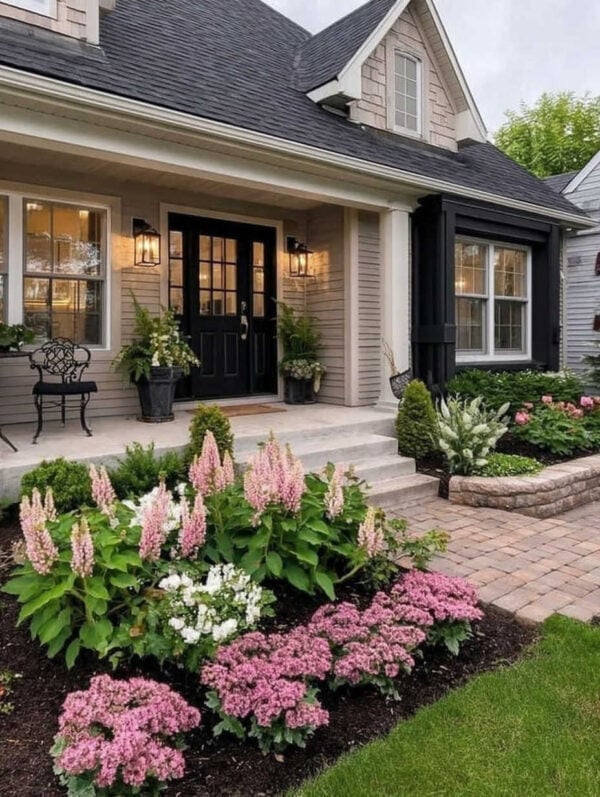
Pink flowering plants fill tiered flower beds that step up along a brick pathway, with a stone retaining wall holding each level in place. The palette runs pink, white, green, beige, and black, and the repetition of the same bloom color gives the yard a cohesive feel. A black front door and wall sconces anchor the house side, while potted plants on the steps add height. The tiered layout solves a slope problem without excavation work. Each bed drains into the one below, so water flows naturally. The brick path ties the levels together, making the narrow front yard feel wider than it is.
Concrete stones on white gravel path
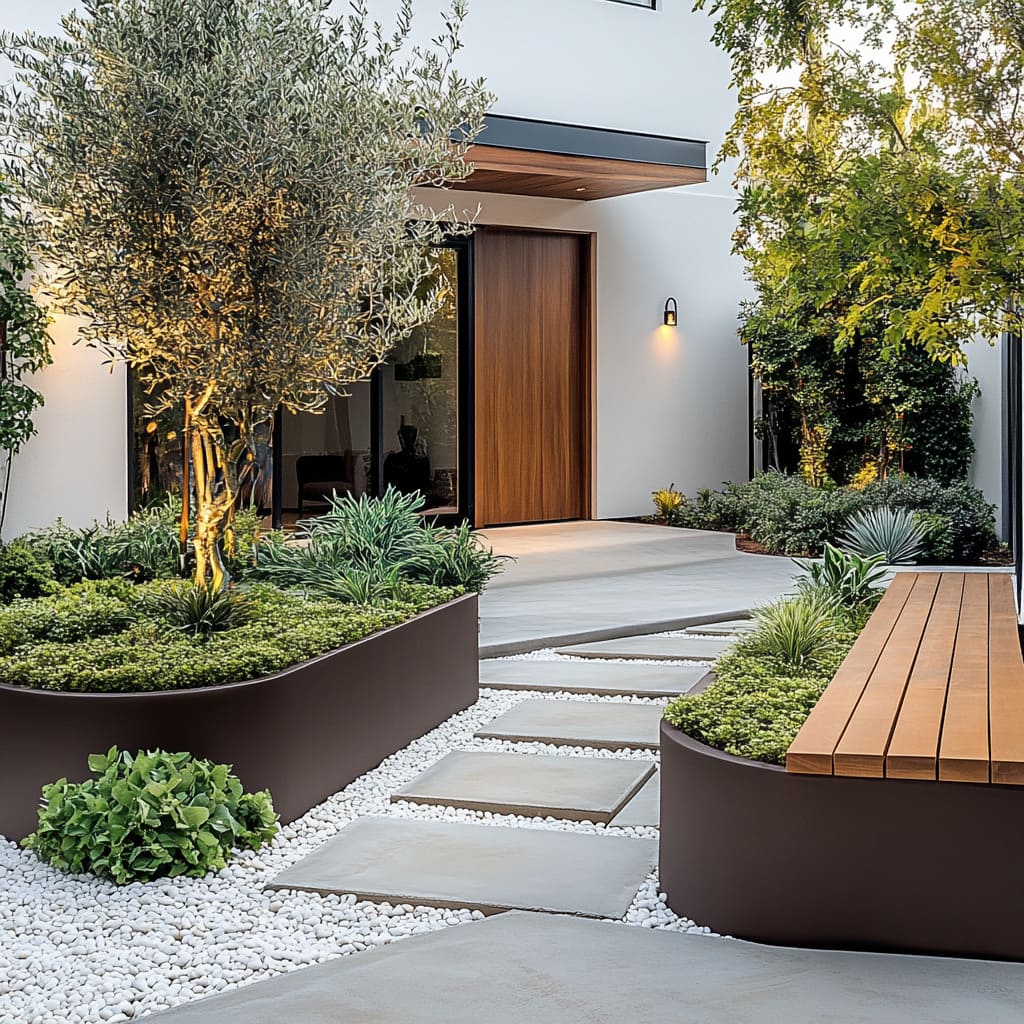
A curving pathway of concrete stepping stones on white gravel leads through an open backyard, with raised planters and a wooden bench placed along the route. The layout works because the path does not aim for the shortest line. It curves gently, slowing the pace and giving each planter its own moment. Uplighting on a nearby tree and a wall sconce on the house extend the path’s use into evening. The concrete stones stay cool underfoot and contrast with the warm wood tones of the bench and planters. Large planters break the sightline, so the yard reveals itself in sections rather than all at once.
Serene backyard with a winding dry creek bed
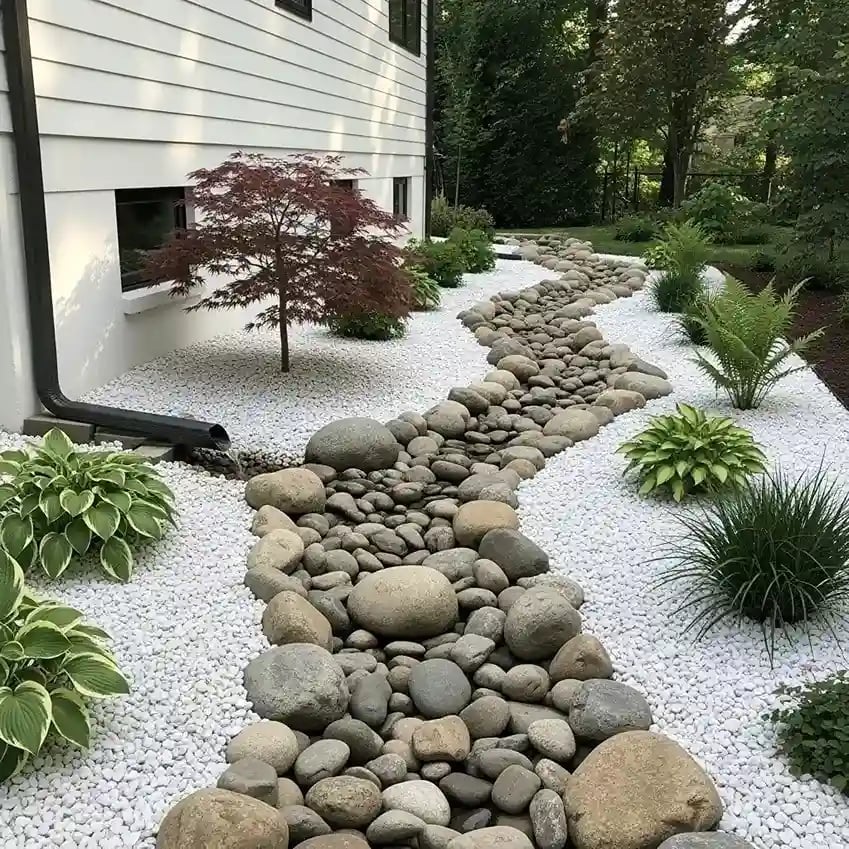
A traditional lawn needs mowing, watering, and weeding. A dry creek bed asks for none of that. The design here uses white gravel as the bed material, with larger stones lining the edges and a few boulders placed along the curve for visual weight. Japanese maple, hosta plants, and ornamental grass soften the hardscape. The wood siding on the house behind the bed adds warmth against all the gray and white stone. The layout follows a natural winding path through the open space, which makes the yard feel larger than a straight line would. The palette stays within white, gray, green, and brown tones, so the dry creek bed becomes the hero element. To recreate it, mark the path with a garden hose first and adjust the curve until it looks like water would naturally flow there. Dig out the path a few inches deep, line it with landscape fabric, then fill with gravel. Place the larger stones along the edges and tuck a few boulders into the curve to break up the line.
Lush cottage garden backyard with overgrown brick path
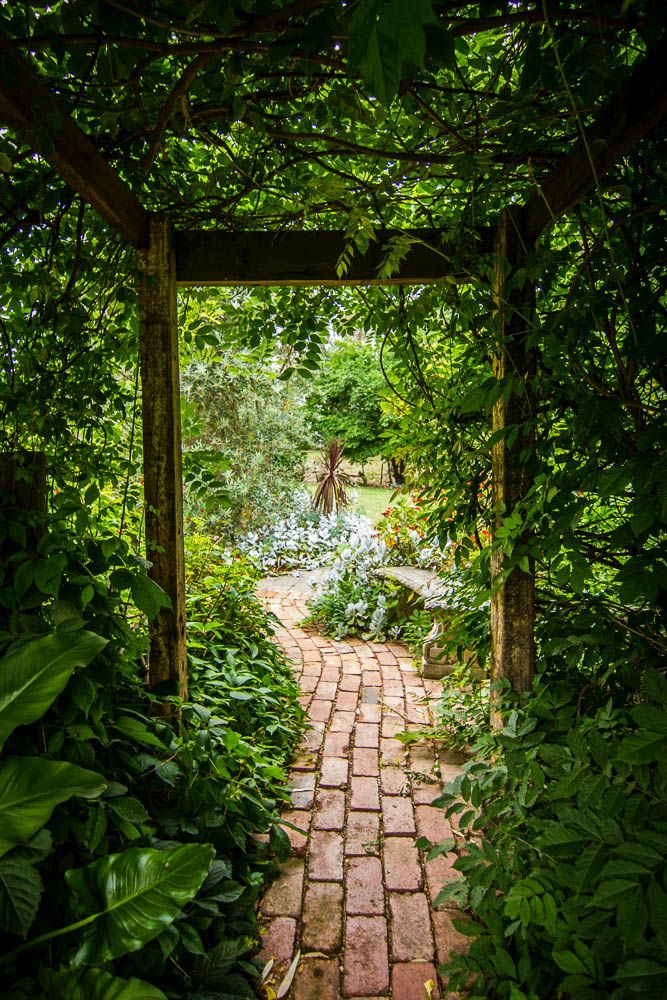
The brick pathway here does not cut a clean line through the yard. It curves gently toward the garden area, and the greenery around it has been allowed to spill over the edges. A stone bench and a stone planter sit off to the side, partly hidden by the leaves. The path leads somewhere, but the destination is not the point. The point is the walk itself, with the red-brown bricks framed by deep green foliage and the occasional white flower. The cottage garden style appears deliberate because the path is solid and the plants are thick. A renter can create the same feel with container plants placed along an existing walkway. Group pots of ferns, hostas, and flowering annuals close enough that their leaves touch, and let a few stems drape onto the bricks.
Mediterranean patio with white lounge chairs and yellow cushions
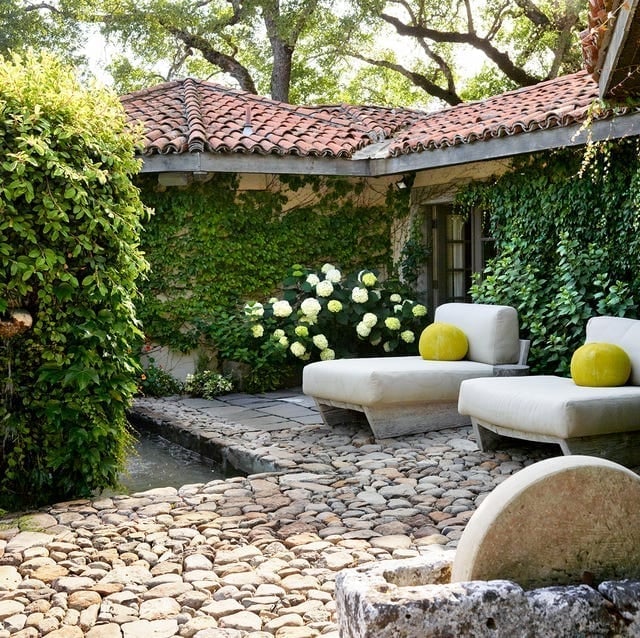
The palette here is what makes the patio work. The two white lounge chairs sit on stone pavers, with yellow cushions that pick up the warm tones in the terracotta tile and the beige stone wall behind them. The hydrangeas and ivy provide a cool green backdrop that keeps the yellow from feeling too hot. The stone path leads through the planting to the seating area, so the chairs feel like a destination. The yellow cushions are the only saturated color in the space, which is why they stand out. A good rule for outdoor seating is to keep the frame neutral and let the cushions carry the color. That way you can swap out the look next season by changing only the cushions. The dappled sunlight on the patio softens the white frames and prevents harsh shadows in the middle of the day.
Naturalistic backyard with curving stone paths and varied evergreens
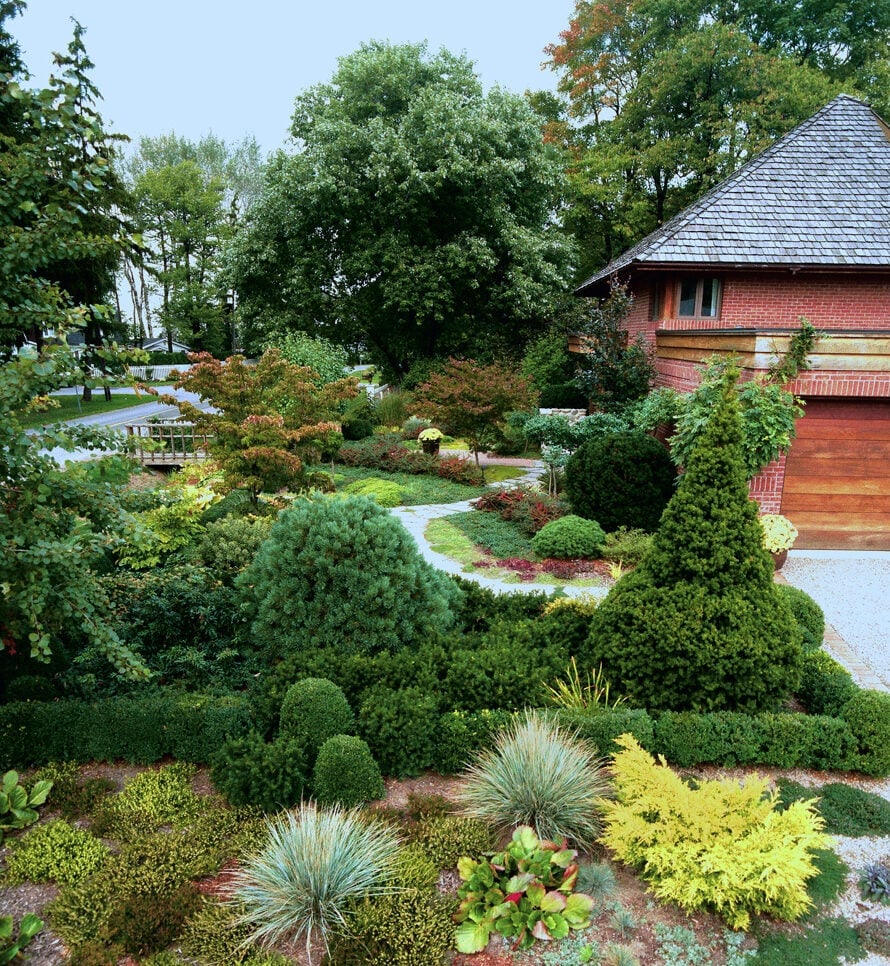
A yard that looks natural still needs a plan. The layout here uses curving stone paths that connect different areas of the garden, with layered planting beds on either side. The paths are made of irregular stone pieces set into gravel, with brick edging in a few spots to keep the gravel contained. The evergreens provide structure year-round: conifers and ornamental grasses hold their shape through the winter, while the deciduous trees add seasonal color in the fall. The palette runs through greens, reds, yellows, and browns, which means the yard looks good even when nothing is in bloom. The question most people have about this style is how to keep it from looking messy. The answer lies in the paths. As long as the stone path is clearly defined and the edges are maintained, the planting beds can be as loose and layered as you want. The path becomes the organizing line that makes the abundance around it look planned.
Cottage garden backyard with winding stone pathway and hydrangeas
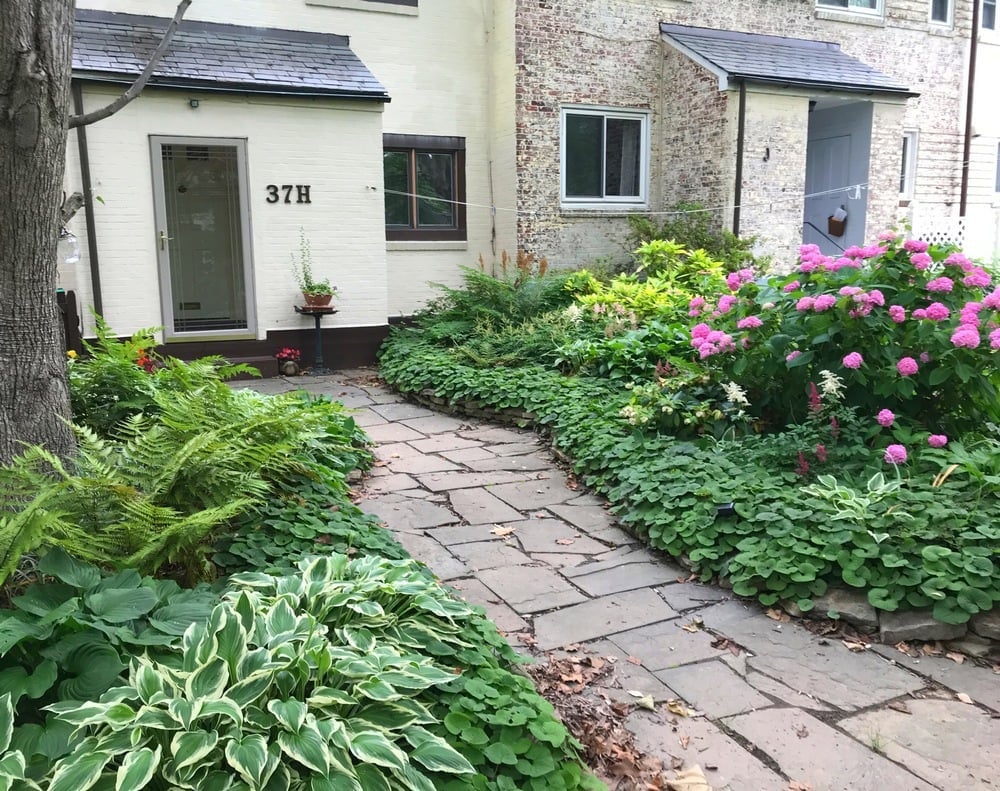
The winding stone pathway here is made of irregular pieces of stone, brick, and slate set into the ground, with the joints left open for moss or small ground covers to fill in over time. The path curves around a large pink hydrangea bush that anchors the whole planting bed. Hostas and ferns fill in the lower layer, their broad leaves contrasting with the fine texture of the ferns. The daylight hits the pink blooms and the beige stone at different angles throughout the afternoon, so the path catches light in some spots and stays in shadow in others. That variation in light is what keeps a cottage garden from looking flat. The path leads the eye through the space, but the hydrangea is the stopping point. If you have a single large shrub that blooms heavily, give it room to spread and let the path circle around it rather than cutting straight past it.
Purple salvia blooms for rock garden
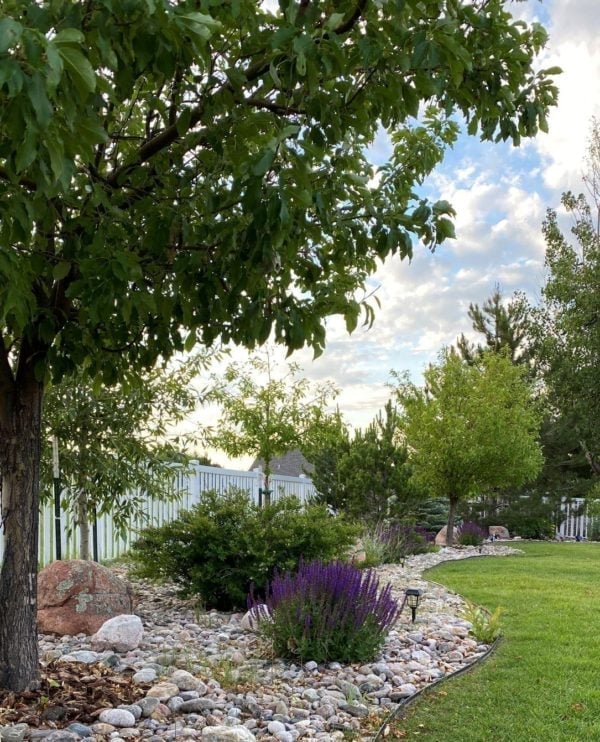
A rock garden bed looks deliberate when you repeat one color at a higher density than anything else. Here, the purple salvia clusters in the middle of a curving bed, so the eye lands there before it travels to the gray boulders or the ornamental trees behind them. The palette stays simple, green, purple, gray, white, which keeps the garden from feeling busy even with mixed plantings. Solar path lights along the edge of the stone and gravel define the bed after dark. That one dense color pocket makes the whole bed feel planted on purpose.
Large boulders and grasses for modern yard
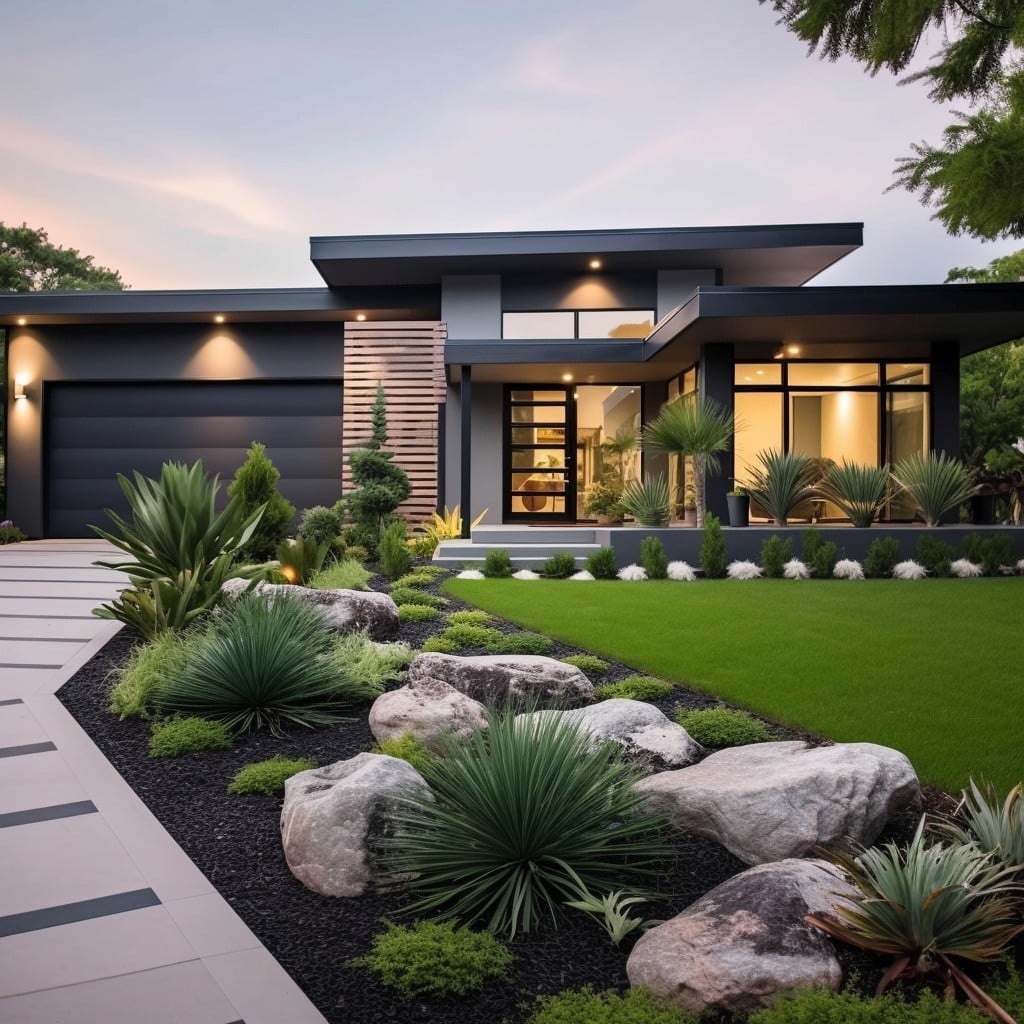
A modern yard can feel cold when every surface is concrete and straight lines. This one takes a different route: it uses large gray boulders as the anchor and lets ornamental grasses soften the edges. The boulders are spaced far enough apart that each one becomes a deliberate sculpture, not a pile of leftover stone. Sloping garden beds carry the eye from the rocks down to a manicured lawn, and the modern house behind them provides a clean backdrop. Exterior spotlights pick up the texture of the stone at night, while interior lights from the house warm the whole scene. The ratio of hard materials to soft greenery keeps the yard from feeling sterile. It breaks the rule that modern has to mean minimal planting.
Conical trees border concrete pathway
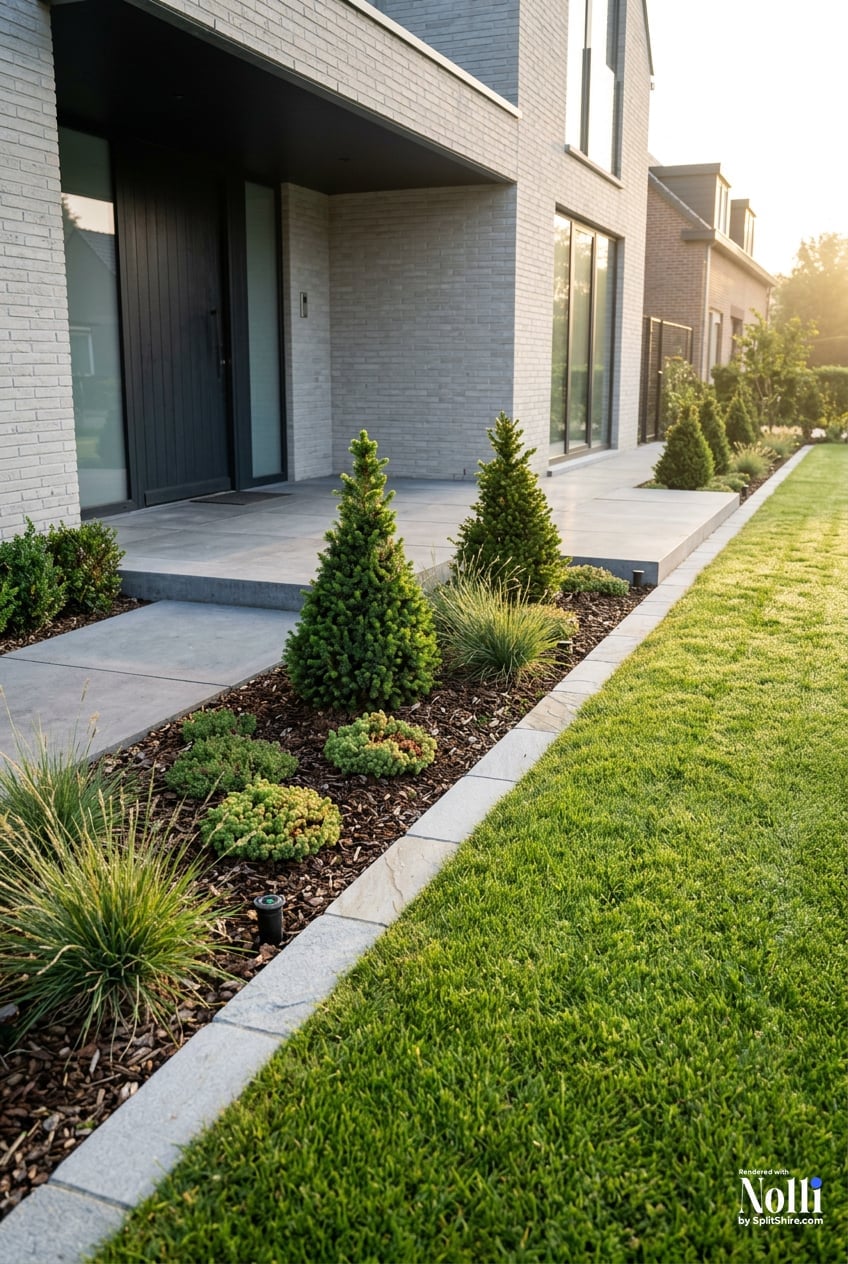
The concrete pathway here is straight and simple, but what makes it work is the rhythm of conical evergreens planted along both sides. They repeat at even intervals, creating a sense of entry without needing a fence or a gate. Low-lying shrubs and ornamental grasses fill the space between the trees, so the ground plane stays textured even in winter. The mulch beds along the pathway keep the lawn from creeping into the planting area, which saves you from constant edge trimming. It is a layout that relies on repetition over variety, and that is exactly why it looks modern.
Wide concrete stairs lead to black gate
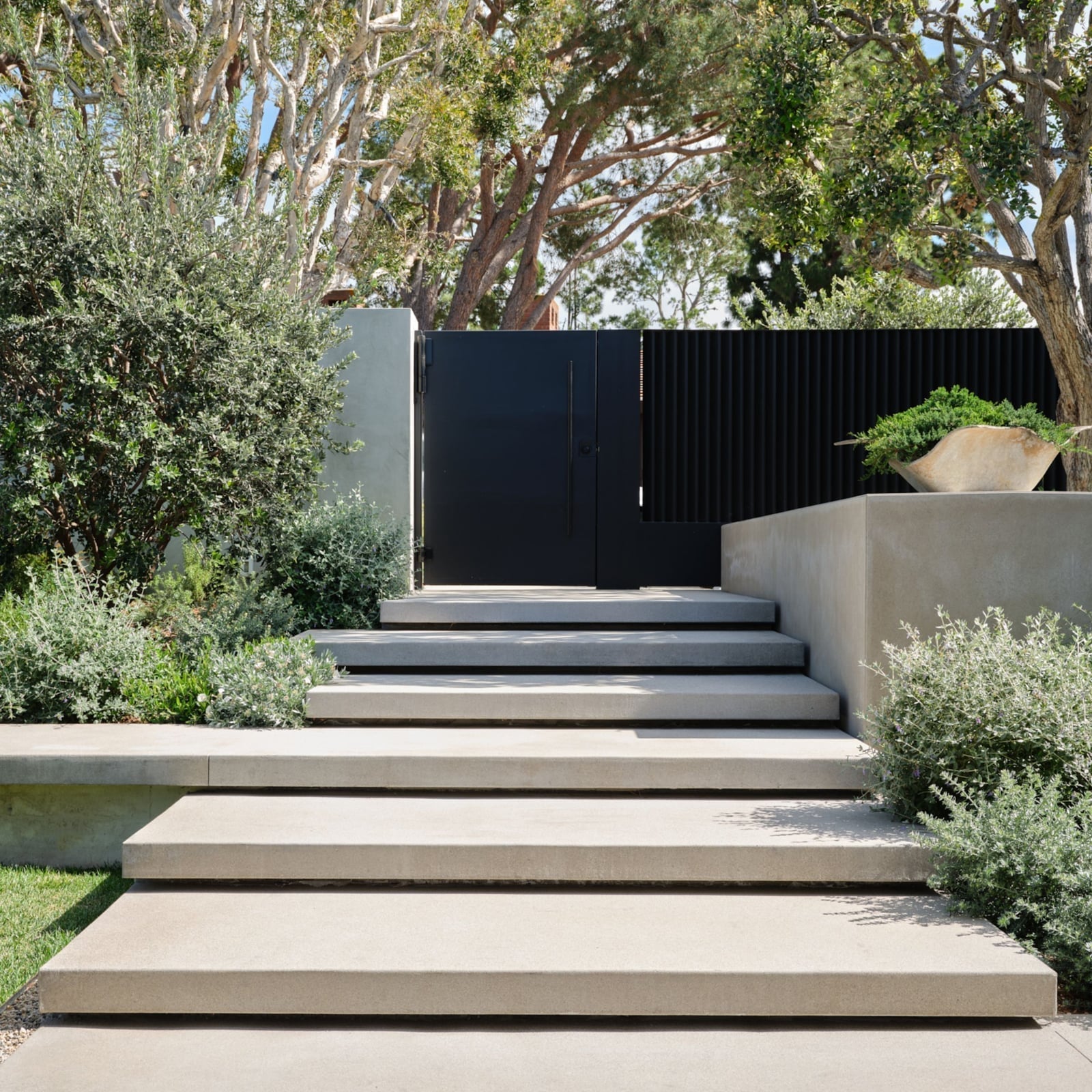
Wide concrete stairs do not need railings when the treads are broad enough to feel stable on their own. Here, the stairs lead up to a black metal gate, and the two materials, concrete and metal, are the only hard surfaces in view. Planter bowls flank the top of the stairs, adding greenery without blocking the gate. The palette stays tight: gray, black, green. That limited range keeps the stairs as the focal point. If you add a third hard material, the stairs start competing with it. This setup works because it trusts one material to carry the design.
Simple yard with a curving gravel pathway and flowering plants
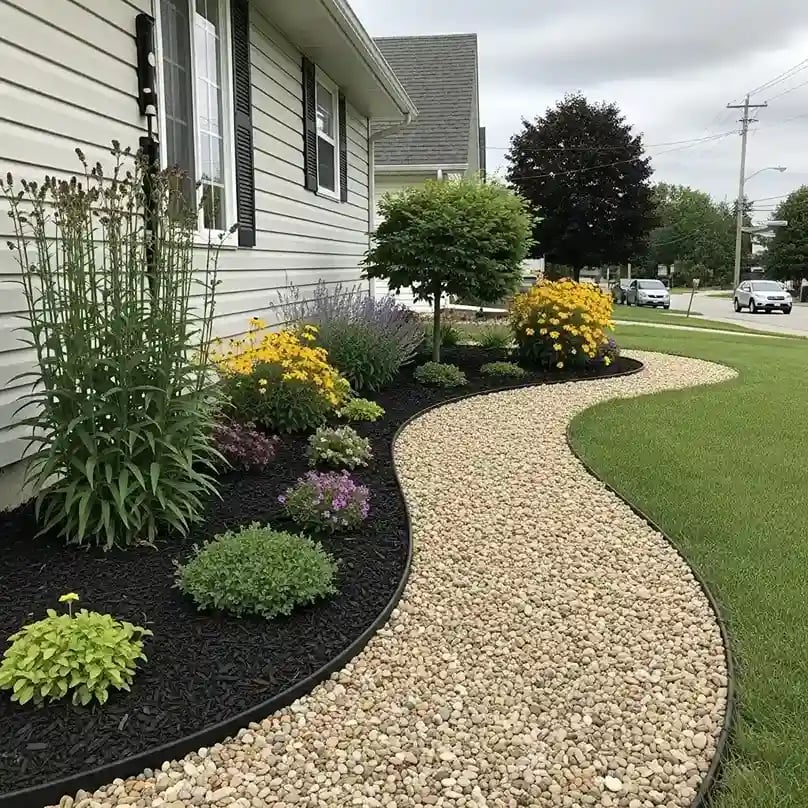
A curving gravel path solves a practical problem: it separates the lawn from the garden bed without needing a hard edge or a retaining wall. Here, the path winds through the yard, and the gravel stays beige so it does not compete with the yellow and purple flowers on either side. Flowering shrubs and ornamental trees are planted in loose groups rather than straight rows, which is what gives this cottage garden its relaxed feel. The path is wide enough for a wheelbarrow, which matters when you are hauling mulch or clippings from one end of the yard to the other. The curve also slows you down as you walk, so you notice the plants at each turn rather than rushing past them. It is a layout that guides movement without dictating it.
Compact backyard with metal pergola and brightly colored cushions
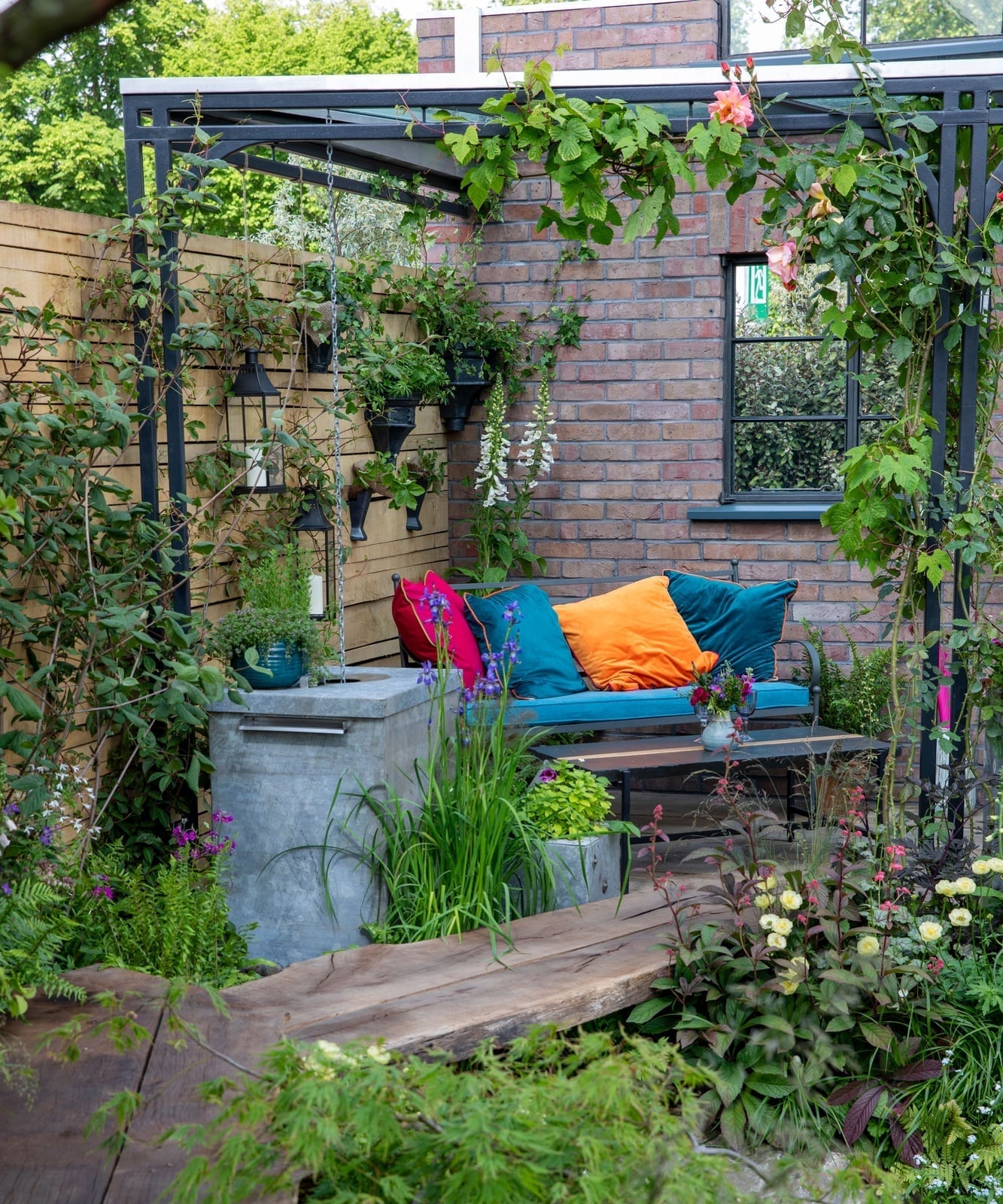
A metal pergola anchors a seating area that makes the most of a compact space. The palette leans on teal and orange cushions against a metal bench, with pink and green plants filling in around the edges. A concrete planter and a wooden bench add different textures without crowding the layout. The bright cushions are what break the usual green-and-brown cottage garden scheme, and they do it without asking for more square footage than you have.
Naturalistic front yard with winding stone pathway and layered shrubs
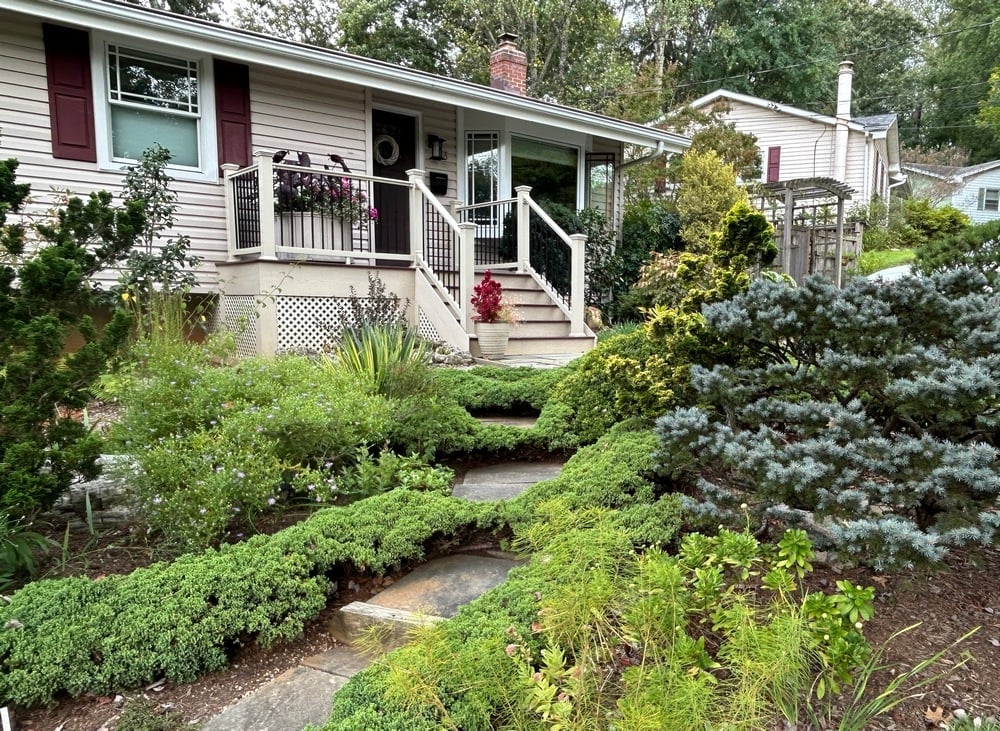
A winding stone pathway is the simplest way to lead the eye through a front yard without adding hard edges. Here it curves through dense shrubs and passes under an arbor, with a potted plant marking the turn. The beige vinyl siding and wood railing on the house stay neutral so the greens and blues of the plantings do the work. For renters, this layout is mostly about what goes into the ground: layered shrubs and a path of loose stones can be adjusted or removed when you move. The arbor adds vertical structure without a permanent foundation.
Asian-inspired backyard with red pagoda and tranquil pond
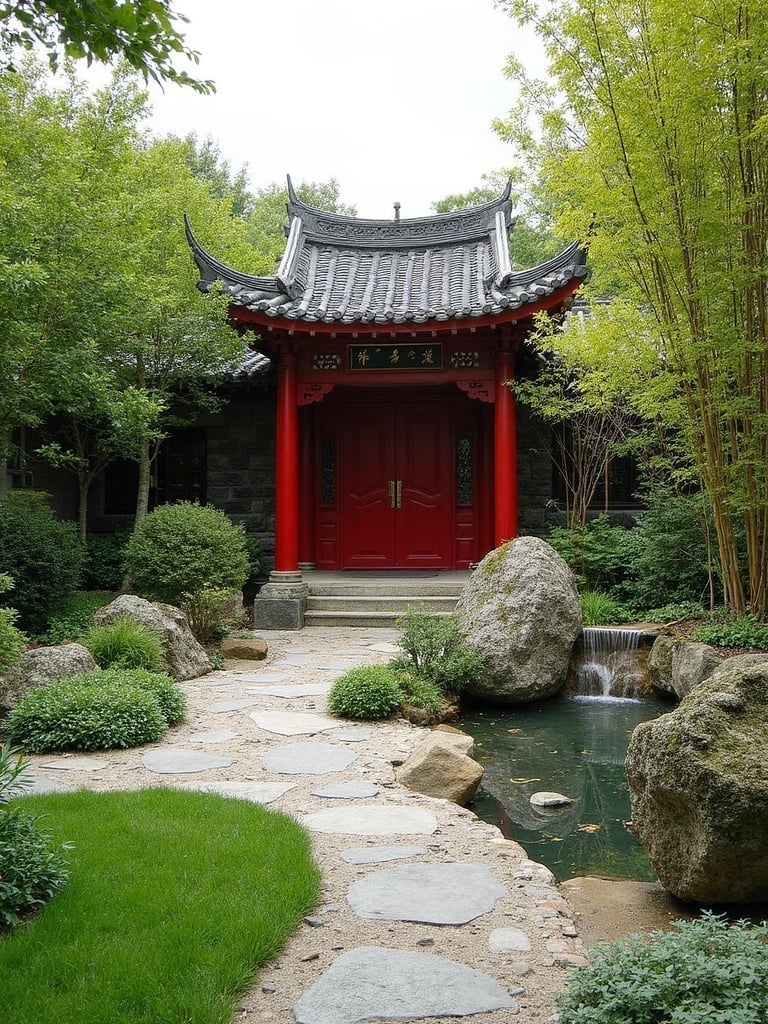
A Japanese-style garden often centers on a single architectural piece, and here a red pagoda entrance sets the tone against gray stone and dark wood. The pond with a waterfall and bamboo planting reinforces the calm, while stepping stones guide you from the path to the entrance. The ratio of red to the surrounding grays and greens is what defines the look: the pagoda is the only saturated element, so it stands out without clashing.
Compared to a cottage garden where every bed competes for attention, this style relies on restraint. The water feature adds sound and movement, and the bamboo softens the hardscape without taking over. What breaks the scheme is anything glossy or plastic: the palette works because every surface is matte stone, tile, or aged wood.
Modern front yard with concrete pathway and ornamental grass
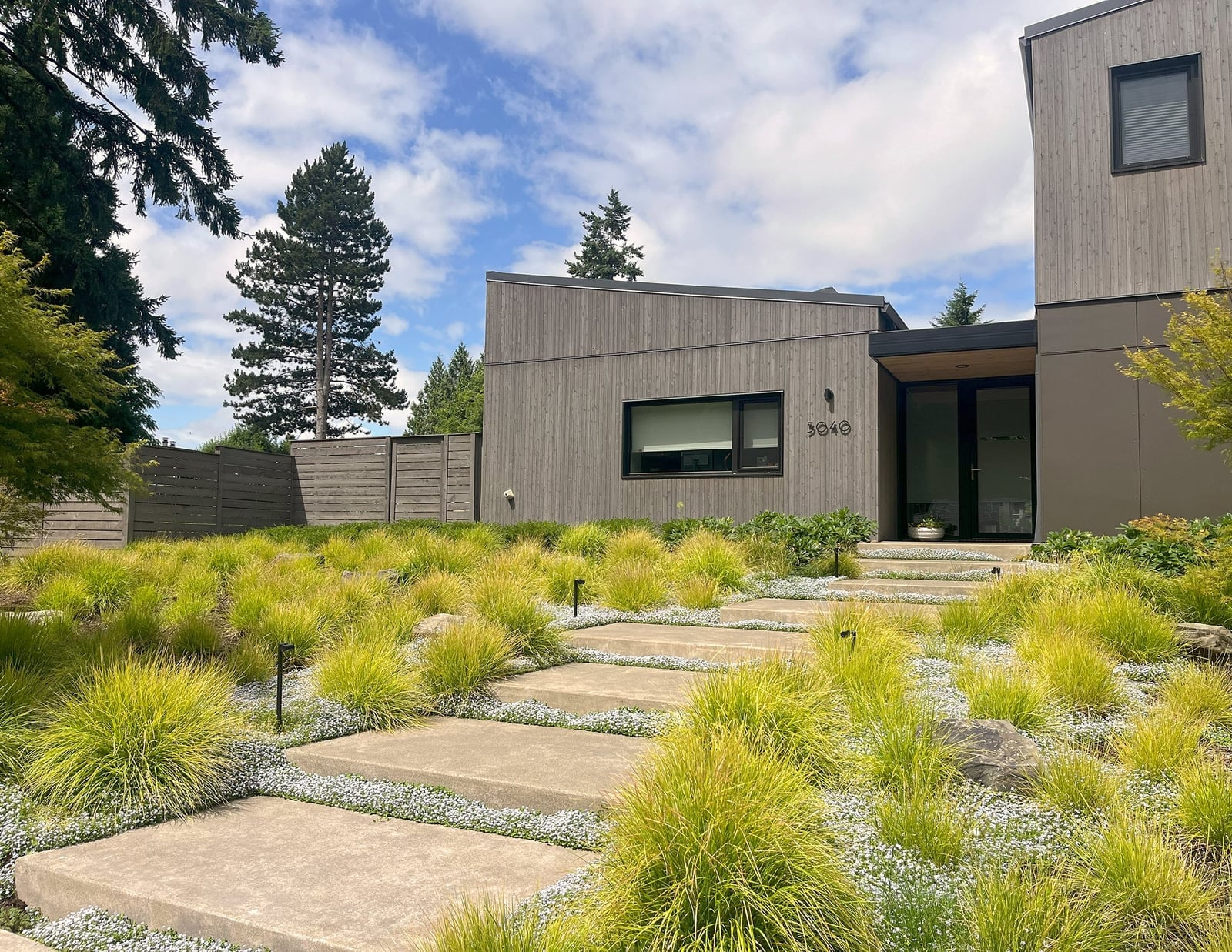
Concrete stepping stones set into a bed of low ground cover create a clean line through the front yard, with ornamental grass adding height and movement. The gray concrete matches the wood siding’s brown undertones, while the white stone border keeps the path defined. Low landscape lights along the edge mean the pathway stays visible after dark without washing out the grass. The ornamental grass is the material that gives the yard its seasonal interest: it moves in the wind and holds its color through frost.
Stone staircase ascends gentle slope
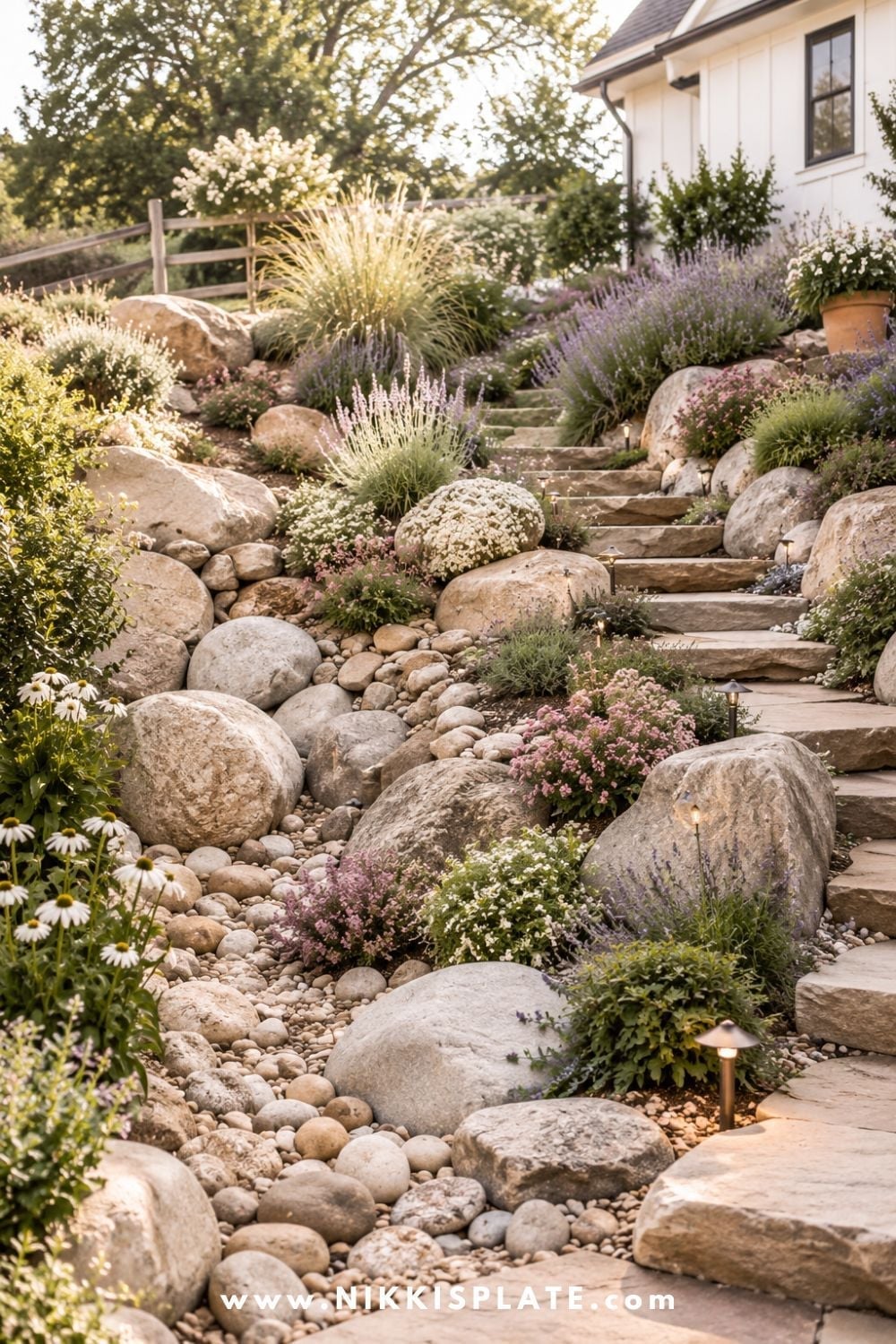
This stone staircase does what a straight run of steps cannot: it follows the slope naturally, with large boulders placed at the turns to anchor the grade. The palette of beige stone, green foliage, and purple flowers keeps the eye moving up without a hard stop. Garden lights set into the gravel at the base of each step make the staircase usable after dusk without overpowering the planting. The scale of the boulders matters here: they are large enough to look permanent features, which is what keeps a winding staircase from feeling like a temporary fix.
Wooden deck and herringbone patio
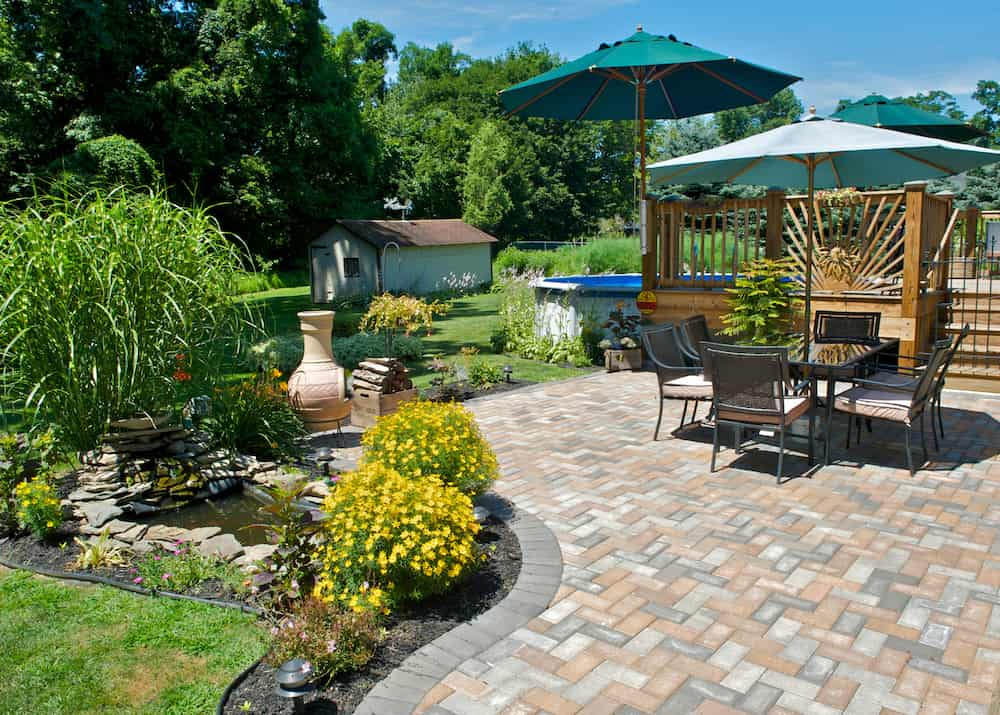
A good layout makes a backyard feel larger by dividing it into zones. Here, a wooden deck sits a level above a paved patio, with the pool and garden beds between them. The dining set and lounge chairs each have their own spot, so the space never feels crowded. The herringbone paver pattern on the patio adds texture without needing another material. Umbrellas provide shade where you need it, and the pond becomes a natural focal point from the deck. The key is giving each activity its own surface and sight line. When the layout handles circulation and seating, the yard lives like an extra room.
Linear stepping stones lead to door
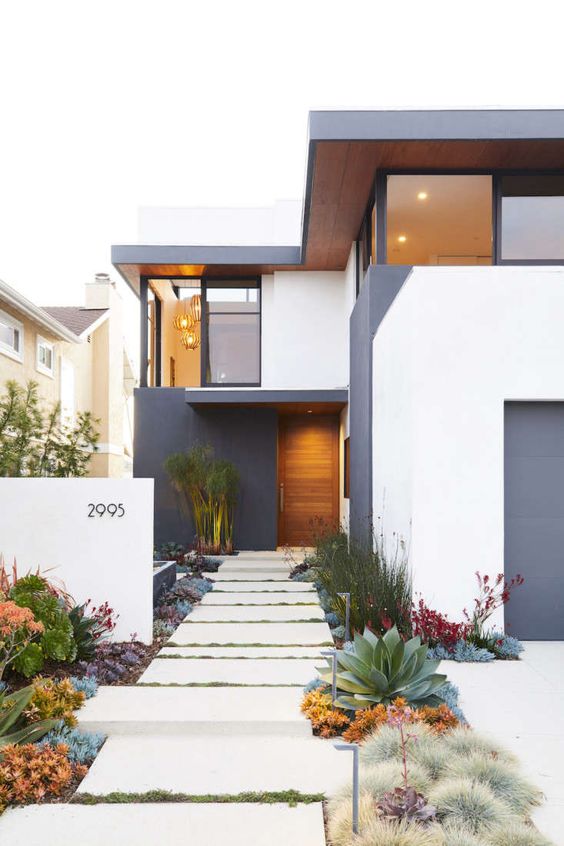
A front pathway sets the tone for the whole house, and geometric concrete stepping stones do it with precision. The straight line between the large agave and ornamental grasses creates a clean approach. Warm wood tones on the door and orange accents balance the cool gray stones and white of the house. Pathway lights guide the way after dark, and interior lights visible through the glass doors keep the entry connected to the home. The palette is crisp because the warm elements break the gray.
Aloe and bamboo create drought tolerance
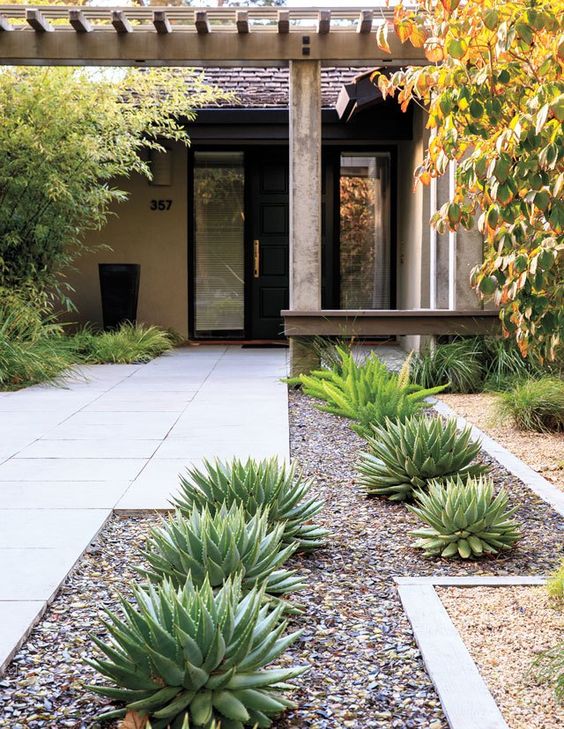
Mixing plants that need little water is the simplest way to lower upkeep in a front yard. Aloe and bamboo both handle dry spells well, and their different shapes add contrast without extra work. Stone gravel beds keep moisture in the soil and stop weeds from taking over. Concrete planters give each plant a defined spot, which makes the row of aloe along the pathway feel like a deliberate design choice. The beige and gray gravel ties the green plants to the house, so the yard becomes a single, low-maintenance composition.
Stacked stone walls terraced garden beds
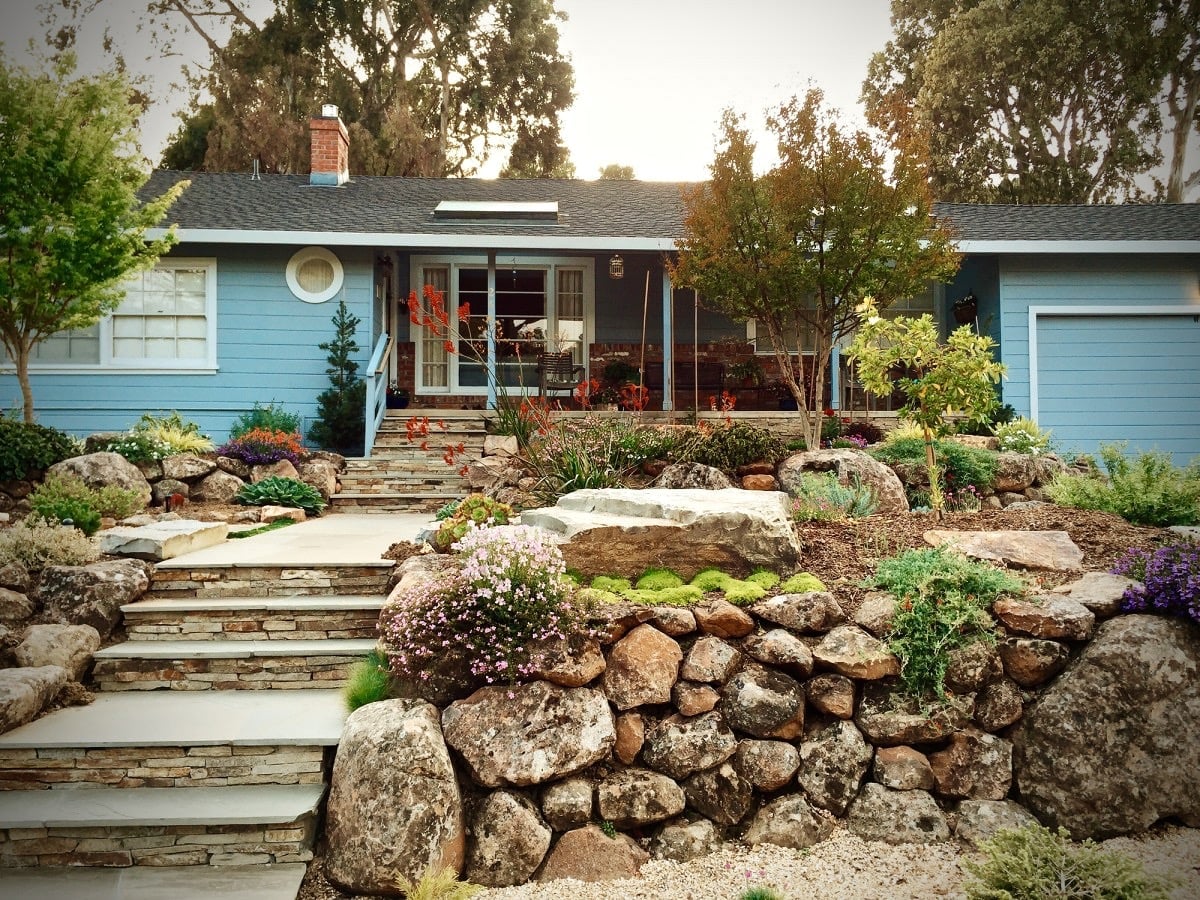
A flat yard is easier to mow, but a sloped one can hold more visual interest. Stacked stone walls turn a gentle incline into terraced planting beds that catch the daylight from different angles. The gray stones and large boulder accents anchor the pink and orange flowers, while the blue and green foliage softens the hard edges. Wood elements and gravel paths break up the stone so it never feels like a retaining wall project. The layout follows the natural slope, which means less digging and more planting. For a rented space, the same effect works with freestanding stone planters placed in a staggered line.
Spherical sculptures in gravel beds
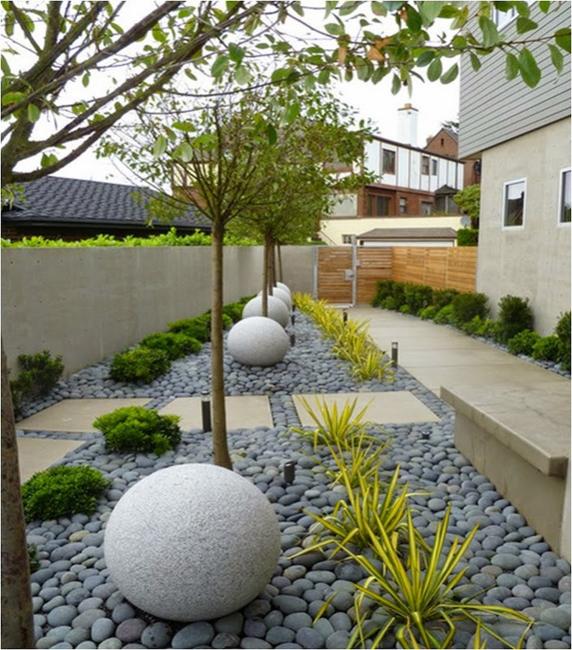
Large spherical sculptures turn a modern backyard into a gallery without needing to change the plants. The concrete spheres sit in gravel beds between slender trees, with a concrete bench offering a place to sit. Pathway lights run along the linear walk, and the planted squares keep the green from feeling sparse. The beige gravel and gray stone are neutral enough that the spheres become the focal point. For a similar effect in a smaller yard, a single sphere paired with one tall grass can carry the same sculptural weight.
Charming backyard with winding stone path and yellow flowers
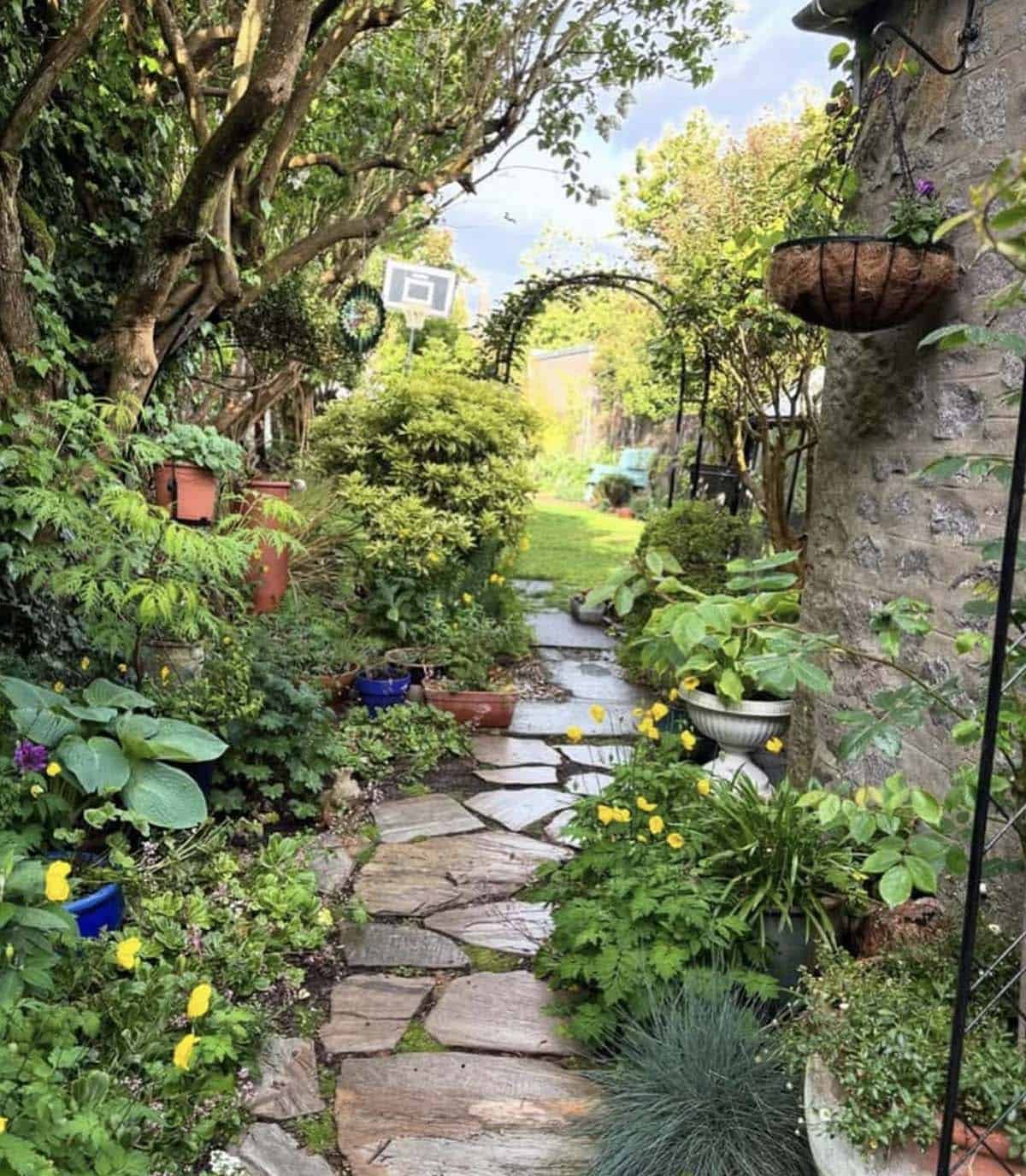
This cottage garden uses a winding stone pathway as the backbone of the whole yard. The path pulls the eye through a mix of green foliage, yellow blooms, and blue accents, with terracotta pots and a metal arch adding texture. A hanging basket near the house softens the transition from path to entry. The palette stays grounded in brown and green, so the yellow flowers look bright moments rather than a chaotic splash. For a similar feel, let the path curve naturally around planting beds instead of cutting a straight line through them.
Geometric path on artificial turf
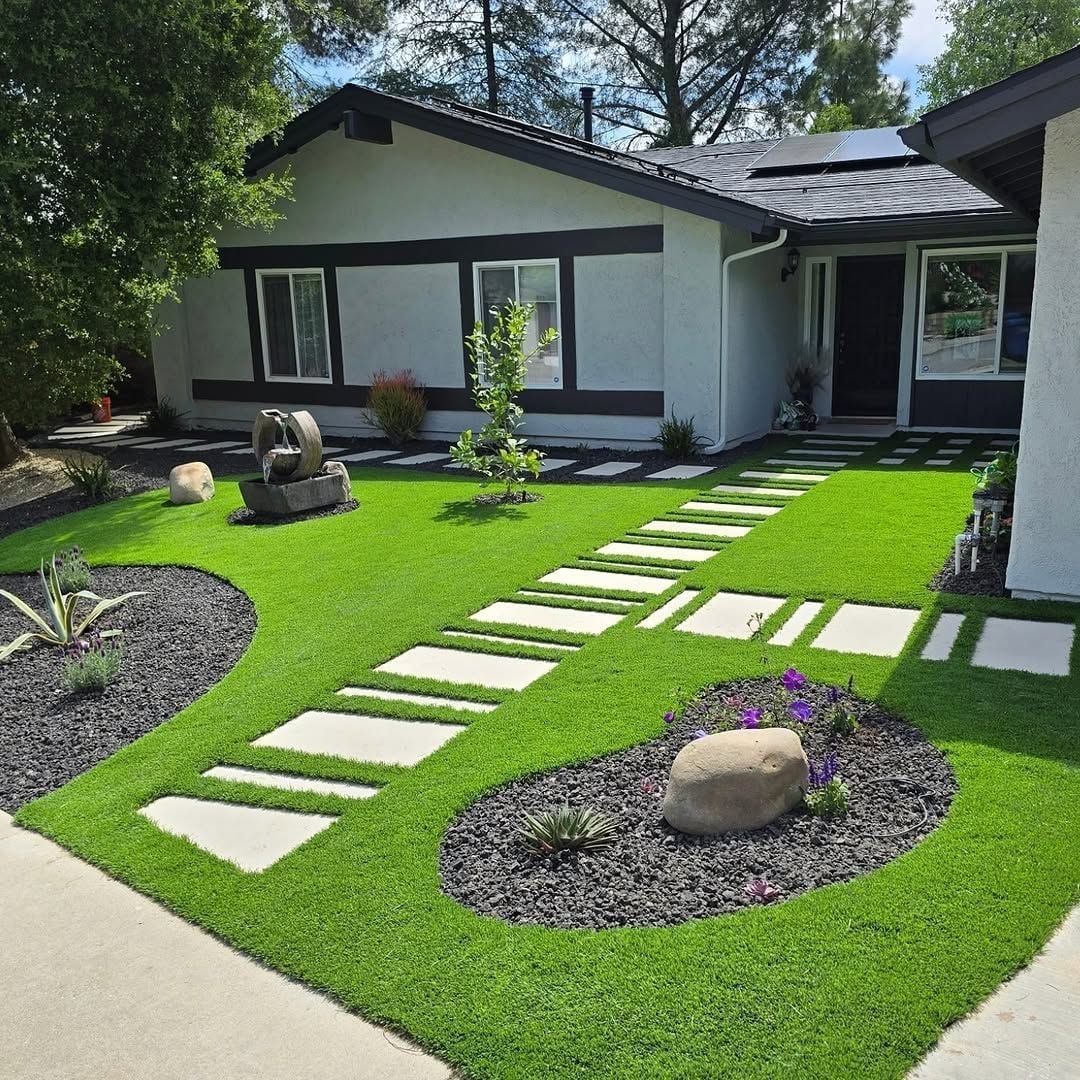
A classic flagstone path can feel too permanent for a rental yard. This modern backyard solves that with geometric stepping stones laid over artificial turf. The crisp rectangles create a deliberate route from the patio toward the house entrance, while the turf keeps the ground green without weekly watering. Large rocks and succulents flank the path, adding weight without blocking the line of sight. A small garden fountain near the house provides a natural stopping point. The layout works because the hardscape shapes are simple: straight-edged stones and clean turf borders give the yard a planned, cohesive look. When the lease ends, the stones can be lifted and the turf rolled up.
Cottage garden with winding stone path and adirondack chairs
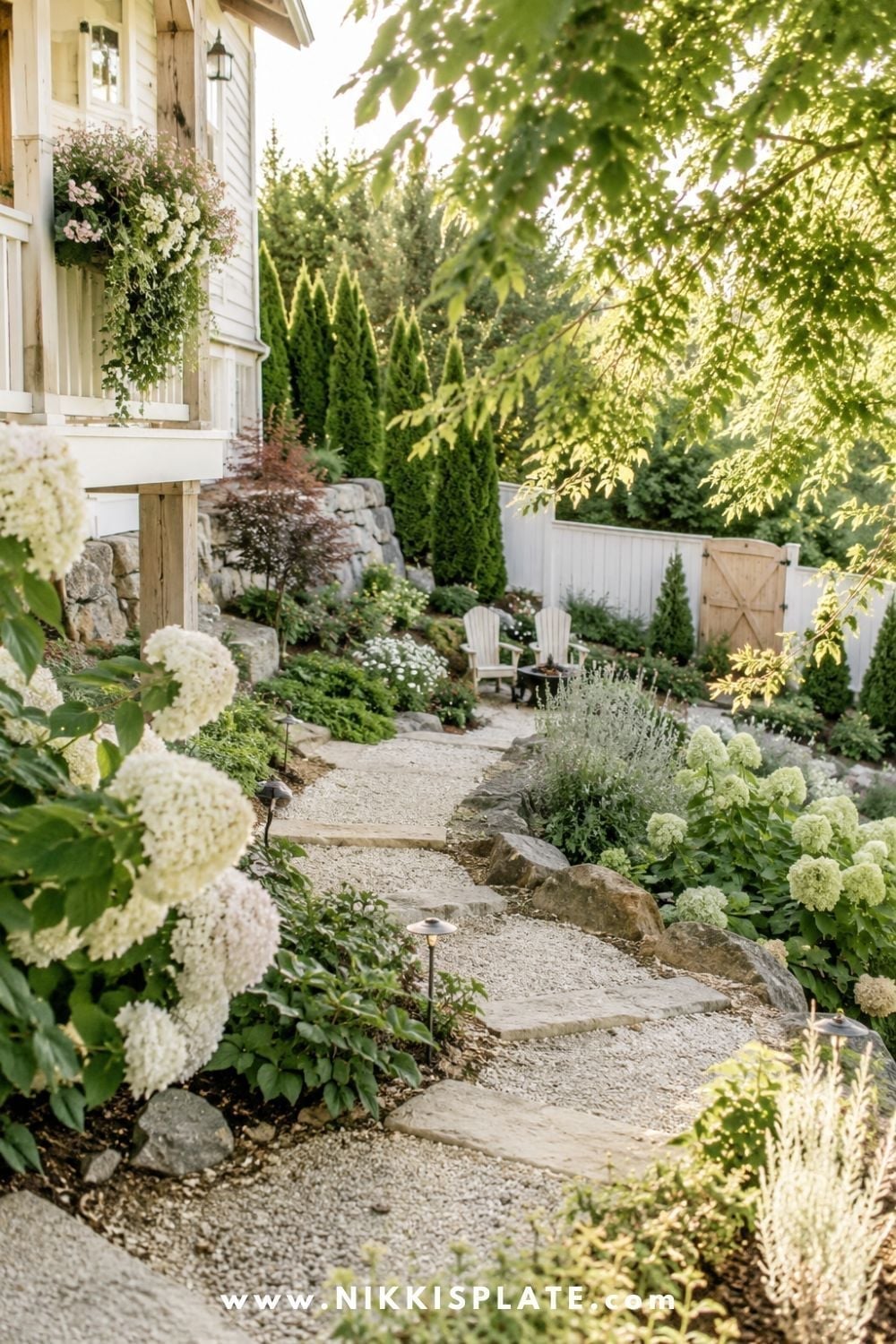
White hydrangeas spill over the edges of a winding stone path that leads past a fire pit and a pair of Adirondack chairs. The chairs are white painted wood, matching the wooden gate at the far end and keeping the seating zone from competing with the flowers. Gravel fills the gaps between the path stones, and pathway lights are tucked low among the plants. The lighting extends the usability of the yard past sunset without washing out the soft green and gray palette.
Modern backyard with winding stone path and large boulder
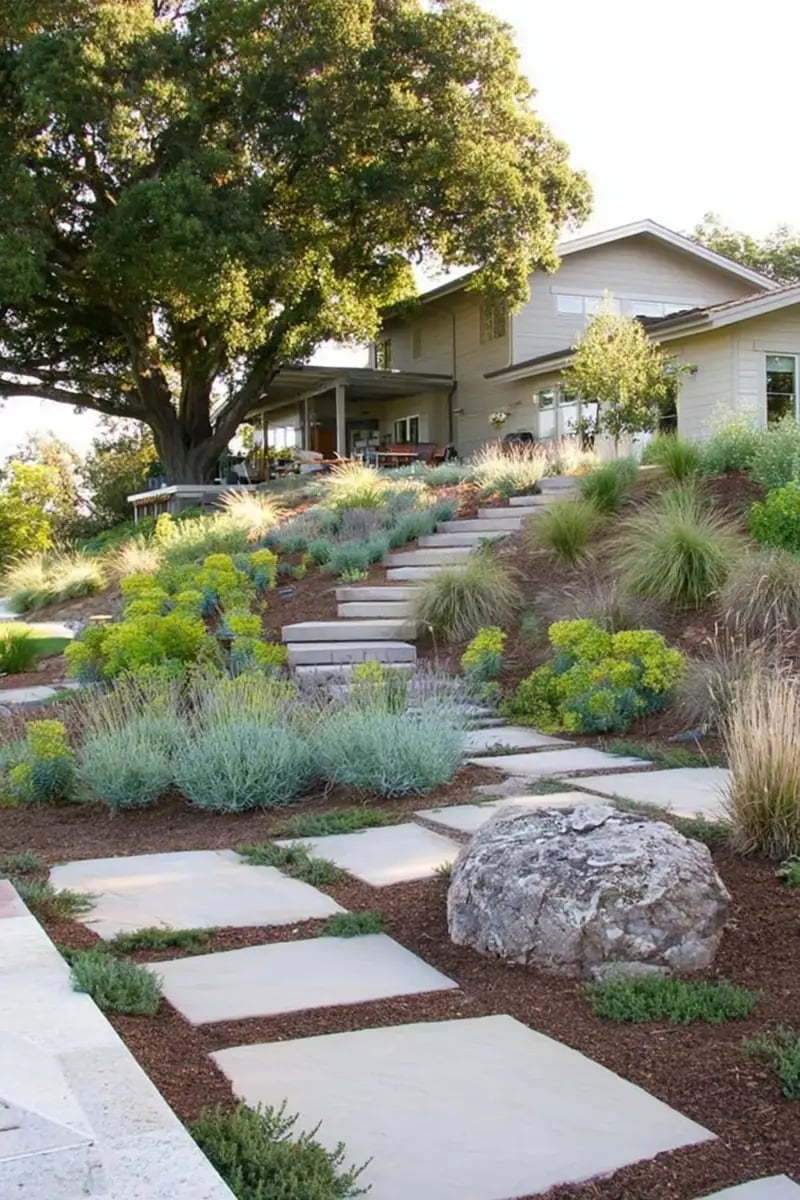
A single large boulder anchors this modern backyard, sitting off the curve of a winding stone path made from concrete pavers. The boulder is the only element that breaks the horizontal lines of the grass and mulch beds, and its gray-beige tone matches the path stones. The path itself does not rush to the destination: it loops around the boulder and past a stretch of open lawn before reaching the patio. In a spacious yard, a path that meanders can feel like a journey rather than a chore, especially when a sculptural object like a boulder gives it a reason to curve.
Final Thoughts
A simple yard starts with a single decision. Pick a path material, a plant that repeats, or a seating spot, and let that set the tone. Across these 29 ideas, the common thread is restraint. A curving gravel path, a row of conical evergreens, or a dry creek bed can shape the whole space without demanding constant upkeep. The best outdoor designs answer the question of how you want to use the space and then step back. Keep the palette tight, the layout clear, and the maintenance realistic for your climate. A simple yard is not a blank yard. It is one that knows what it is for.