
Front yard landscaping sets the tone for your entire home. It’s the first thing guests see, and it can boost curb appeal without a full renovation. In 2027, the trends lean toward a mix of classic materials and naturalistic planting, creating spaces that feel both intentional and lived-in.
Whether you’re after a formal look with geometric hedges or a relaxed cottage garden with winding paths, there’s an approach that fits your home’s style and your weekend schedule. This article rounds up 22 ideas that balance aesthetics with practical upkeep, so you can pick the one that makes sense for your yard, your climate, and how much time you want to spend weeding.
Traditional elegance with curving paver walkways and lush greenery
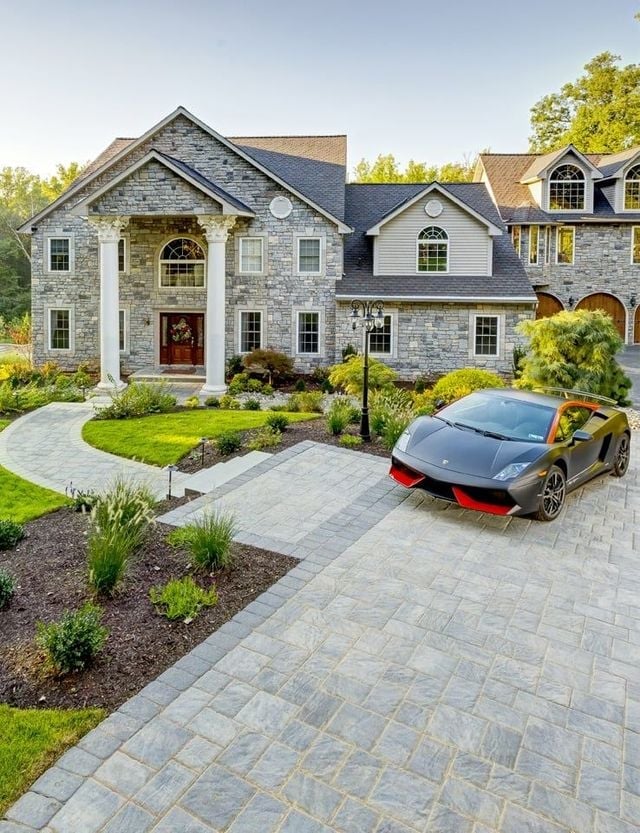
A curving paver walkway and a paved driveway set the bones of this front yard, where stone and mulch beds frame the path with layered green and white plantings. The layout leads the eye along the curve toward the house, and low landscape lights mark the edge during daylight hours. A luxury car parked on the drive hints at the scale, but the real anchor is the stone house itself, which keeps the whole scene grounded in traditional proportion.
Modern gravel garden with a stepping stone path and birch tree
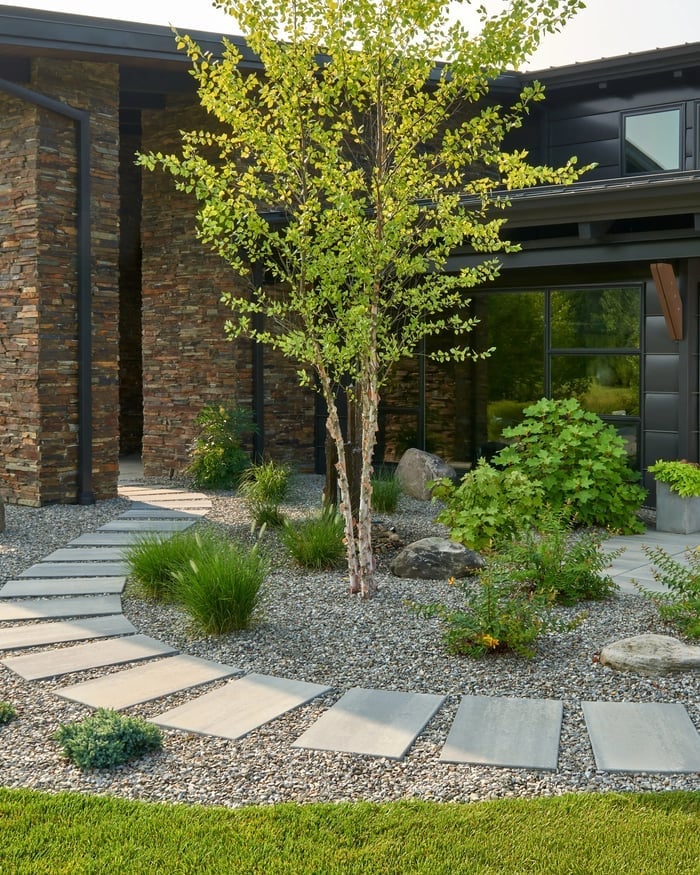
This front yard swaps a traditional lawn for a gravel garden for a clean, low-water look that still feels full. A curving path of flat stepping stones cuts through dark gray gravel, with a white birch tree and a few large rocks acting as natural punctuation. Ornamental grasses add soft texture at ground level, and the metal edging keeps the gravel from straying into the planted areas. The narrow range of gray, green, and brown means nothing competes with the birch’s pale trunk.
Charming traditional pathway with ferns and manicured bushes
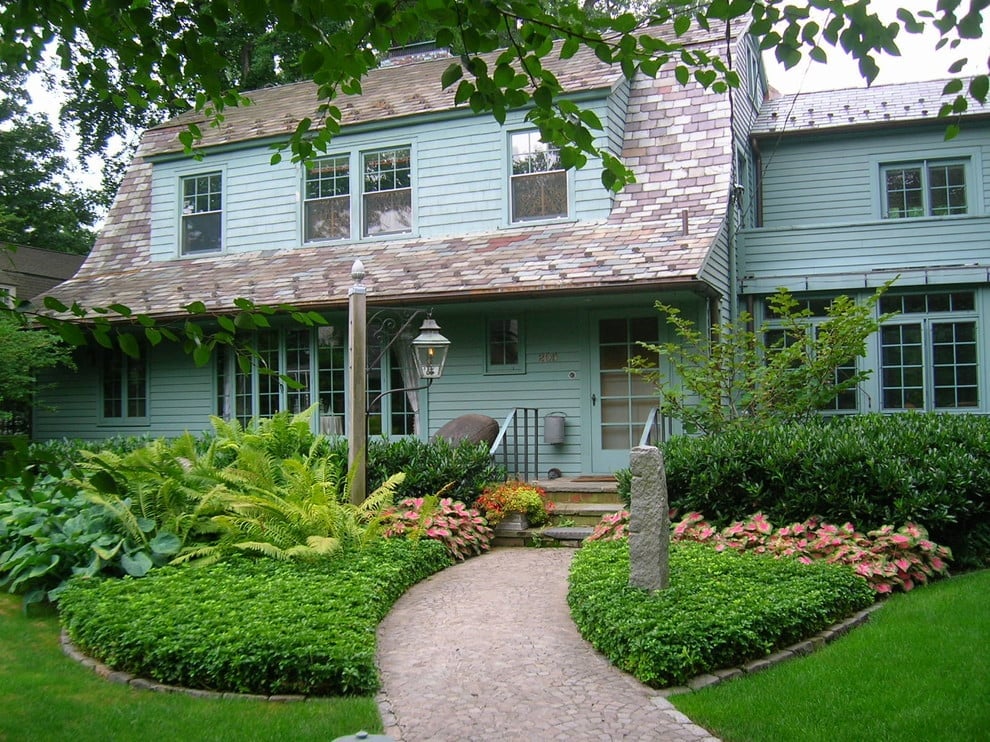
What makes a traditional pathway feel inviting rather than just functional? In this front yard, the answer is layered planting beds that soften the hard lines of stone and slate. A curving walkway leads toward a stone pillar and a lamppost, while ferns and manicured bushes fill the beds in shades of green, pink, and light blue. The palette mixes cool and warm tones, so the greenery looks lush without turning monotonous. The lamppost adds a vertical anchor near the entrance, and the stone pathway ties the whole layout together without competing with the plants.
Boho-sharp patio with a fringed umbrella and striped cushions
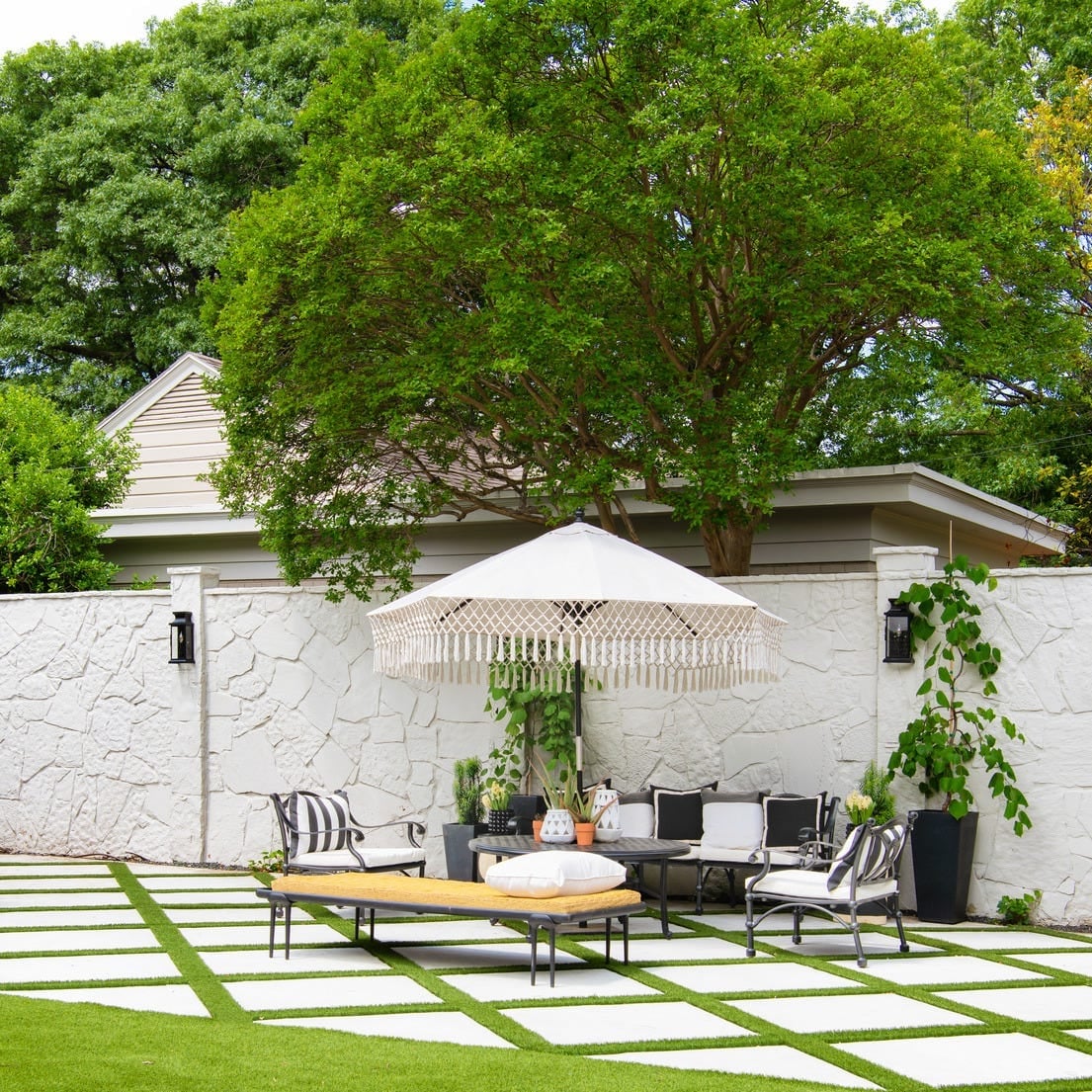
An ornate fringed umbrella in black and white stripes becomes the focal point of this patio, with a seating set arranged around a table beneath it. The palette stays simple with white, black, green, and yellow, and the striped cushions echo the umbrella pattern without matching it exactly. Wall lanterns on the house add warm light for evening use, and a bench in the foreground offers extra seating without crowding the main group. The artificial grass underfoot keeps the patio looking tidy with less upkeep than real turf.
Classic traditional entrance with brick pathway and red maple tree
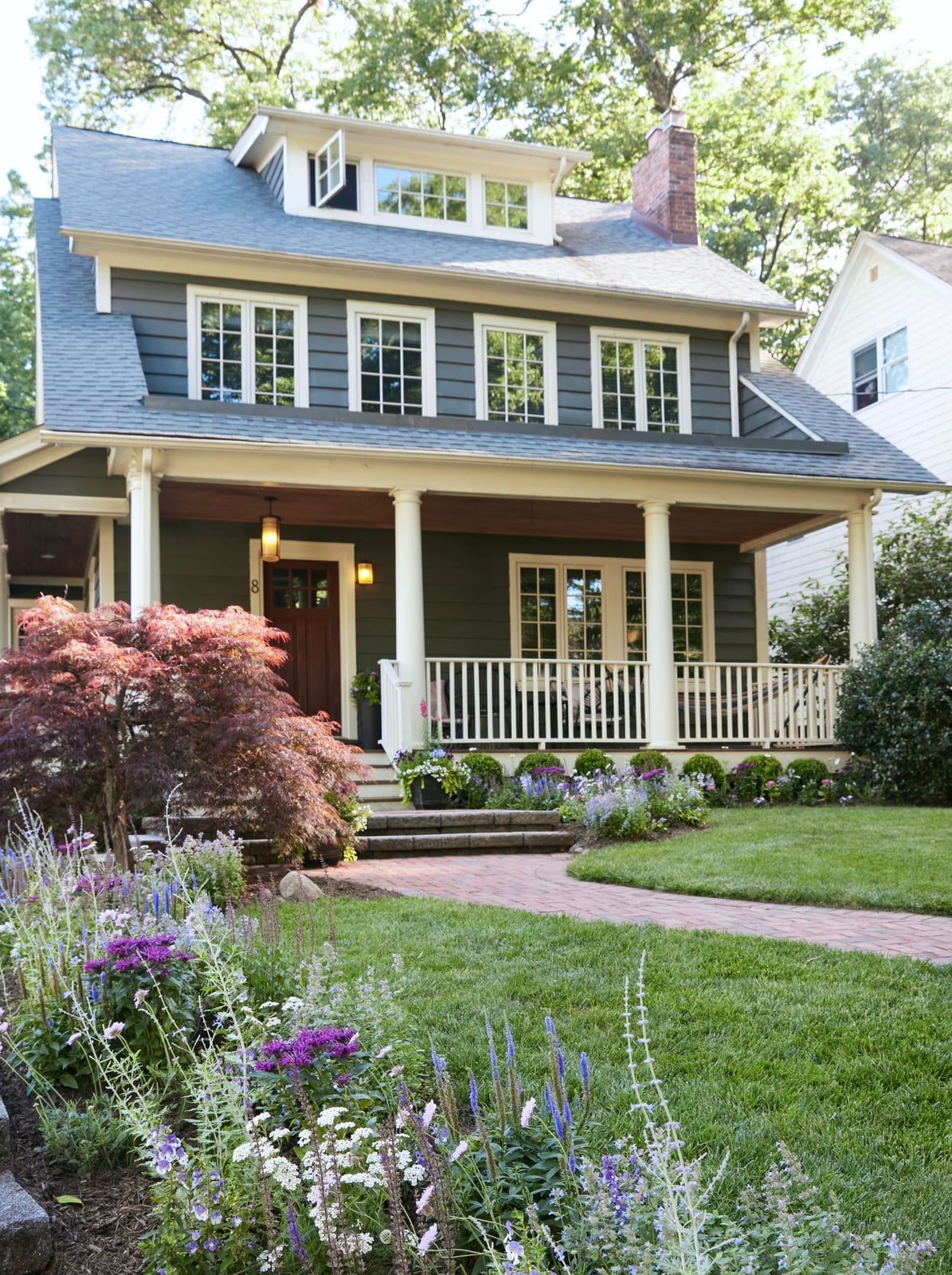
A brick pathway that curves through layered flower beds makes this entrance feel established rather than newly planted. The red maple tree provides a strong vertical accent, while flowering plants in purple, white, and green fill the beds at ground level. The layout works because the path is wide enough for two people to walk side by side, and the porch lights flanking the entrance echo the brick’s warm tones. Keeping the flower beds deep allows room for seasonal rotation without disturbing the path’s clean edge.
Naturalistic tiered rock garden with stacked stone steps
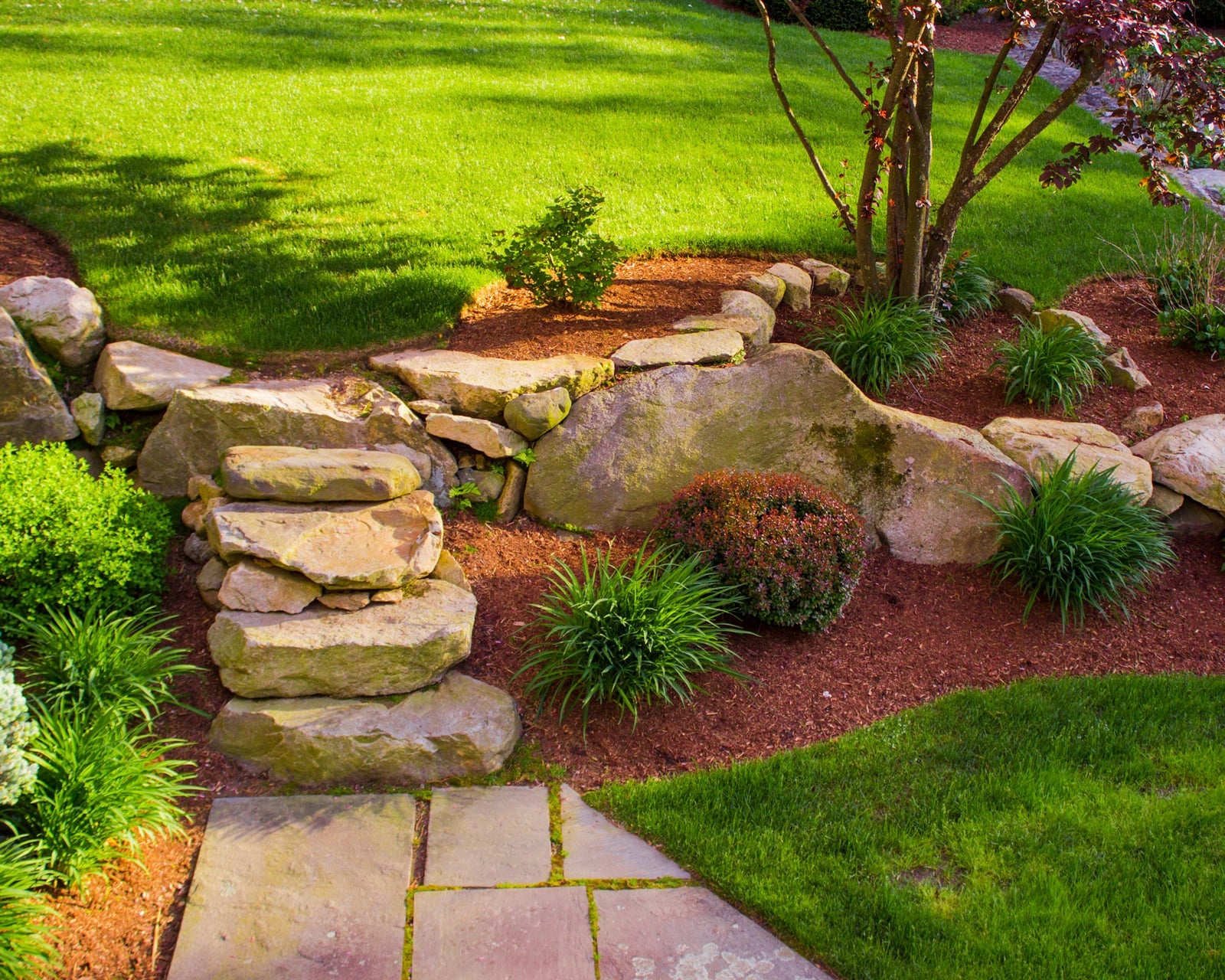
Instead of a formal staircase, consider stacked stone steps that look like they emerged from the ground themselves. The tiered rock garden uses large boulders and ornamental grasses to create a slope that feels deliberate without being stiff. A flowering shrub and a small tree add height, while mulch keeps the soil visible and the palette earthy: green, brown, tan, and red.
The layout works because the path feels like a natural extension of the yard rather than an interruption. In a compact front yard, tiered planting beds give the eye somewhere to travel without needing a big footprint. The material swap here is stone and mulch instead of poured concrete or pavers, which means you can adjust the route as plants fill in.
Cascading greenery frames a modern porch citrus tree
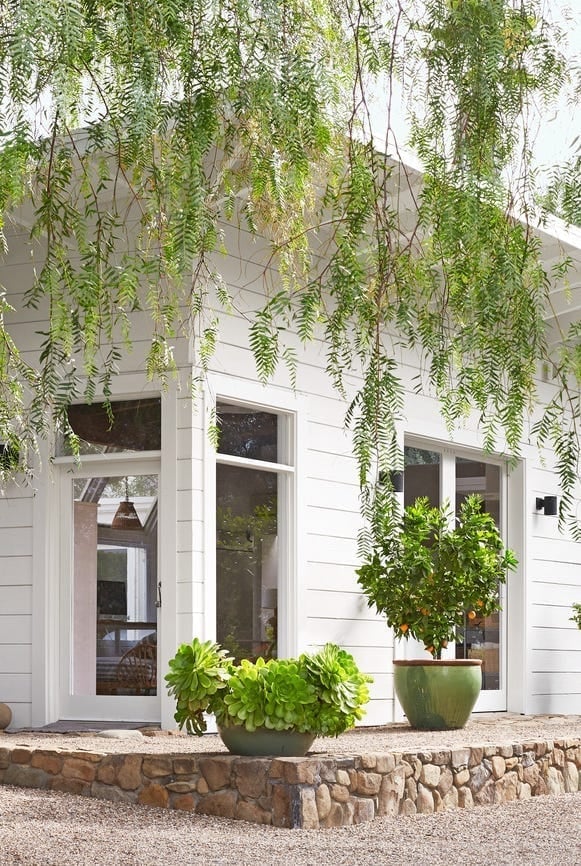
The porch balances hard materials like stone and wood siding with soft, cascading green foliage that spills over the edge of a raised stone base. A potted citrus tree anchors one corner, while a large succulent sits nearby, each plant in a ceramic container. Wall sconces extend the usable hours of the space, but the real trick is the height variation: the tree stands tall, the cascading plants hang low, and the eye moves easily between them. For renters, this setup works because nothing is permanent, pots can shift with the seasons or move indoors when frost threatens.
Winding concrete path past flowers in stone planters
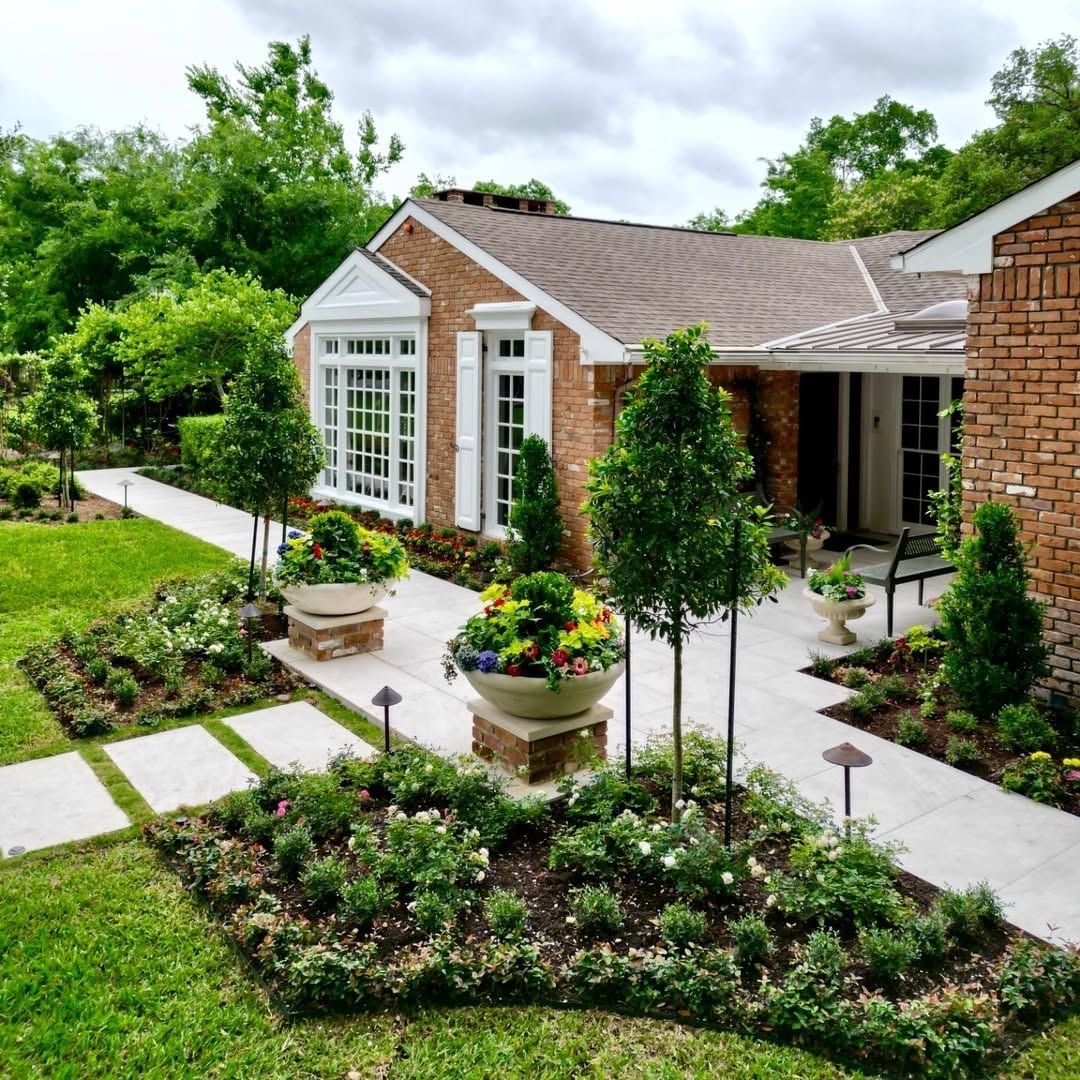
This front yard looks traditional but not stiff, thanks to a concrete path that curves gently past oversized stone planters filled with colorful flowers. The palette mixes green foliage with white, red, yellow, and blue blooms, while brick edging keeps the beds defined. Manicured trees and a simple bench give the space a sense of use, not just display. Pathway lights guide the route after dark, which matters when the walkway is long enough to feel like a journey. The symmetrical planters frame the path without making it feel rigid, and the concrete surface stays cool underfoot during hot afternoons.
Tiered stucco planters with integrated wooden benches
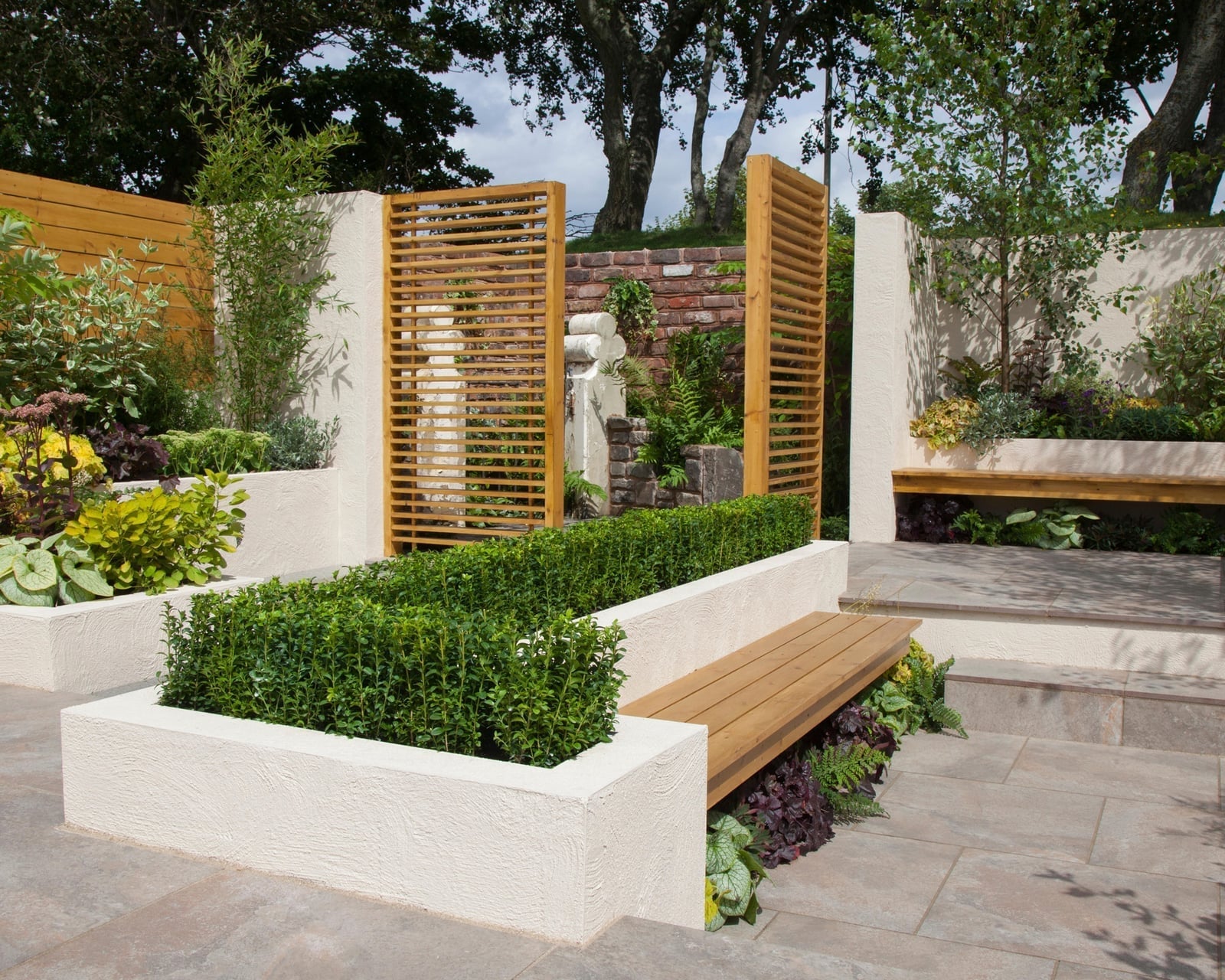
How do you make a front yard feel like a room? Build seating right into the planting. Here, tiered stucco planters rise in cream and green layers, with built-in wooden benches tucked between them. Slatted wooden screens add privacy without blocking light, and the dappled shade keeps the space usable on sunny days. The palette stays calm: cream stucco, warm wood, green foliage, and brick red accents from the tile below.
The layout solves two problems at once: the raised beds keep plants visible and easy to reach, while the integrated benches mean you don’t need to drag chairs out every time you want to sit. For anyone tired of mowing a slope, terracing with stucco planters turns a chore into a destination.
Formal garden with geometric lawn path and hedges
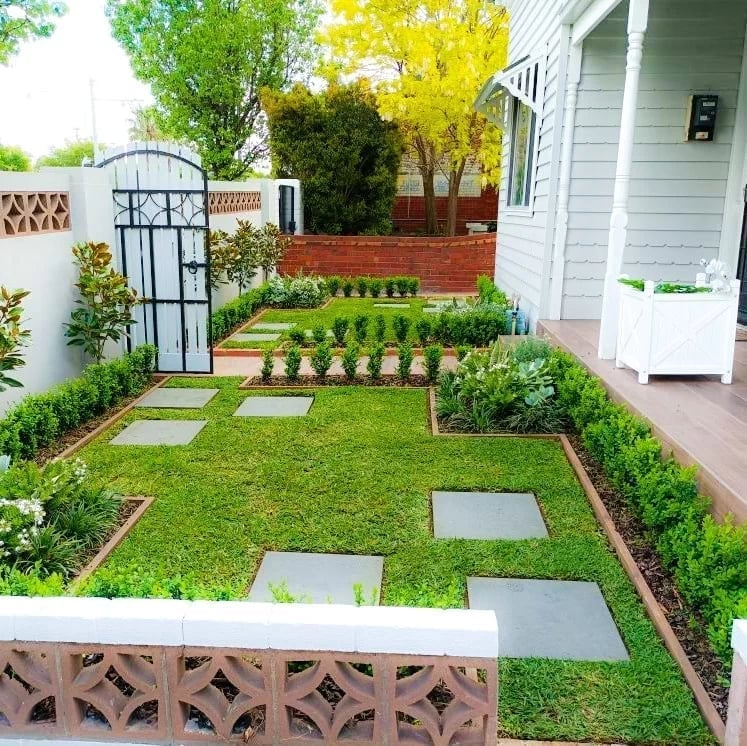
A central lawn path made of square stepping stones cuts through symmetrical planting beds edged in brick. Manicured hedges frame the route, while a white painted planter box adds contrast against the green. A black metal gate marks the entrance, giving the garden a defined boundary. The geometric layout relies on crisp lines and repetition: each side mirrors the other, and the path leads the eye straight to the door. For a roomy front yard, this approach makes maintenance straightforward. The hedges need trimming, but the lawn path stays neat without much effort.
Ornamental grasses and gravel beds complement modern house
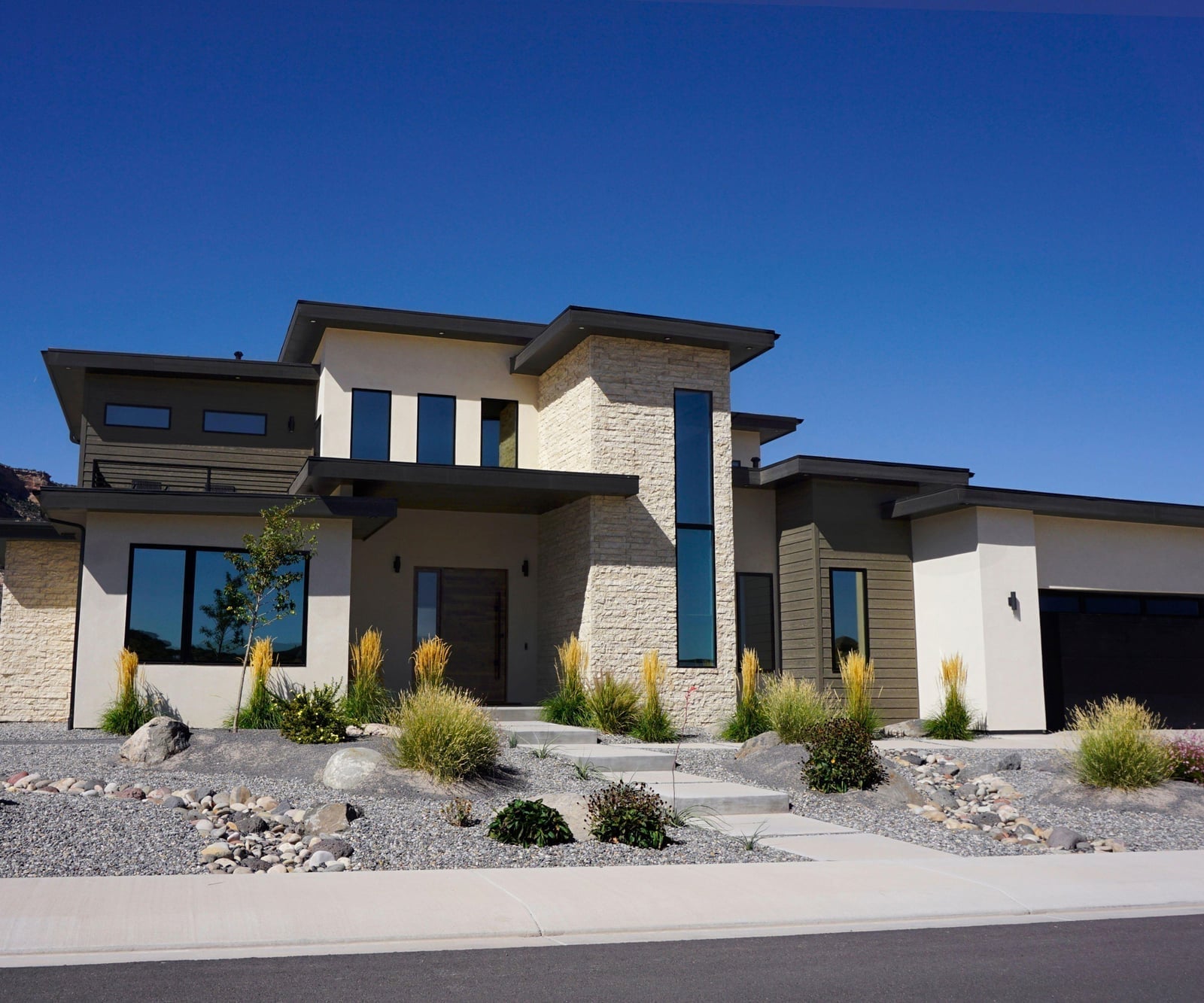
A practical rule for a modern front yard is to let the architecture lead. The clean lines of the house set a neutral backdrop, so the planting beds become the texture. Ornamental grasses in green and yellow soften the concrete steps and stone pathway, while dark brown gravel fills the gaps between the landscaping beds. The palette stays beige, gray, white, and dark brown, with the green and yellow as the only living color. This keeps the view open and the maintenance low: gravel needs occasional raking, and grasses need cutting back once a year. For a renter-safe swap, use large container grasses on either side of the entrance instead of permanent beds.
Contemporary entrance with winding concrete path and vibrant flowers
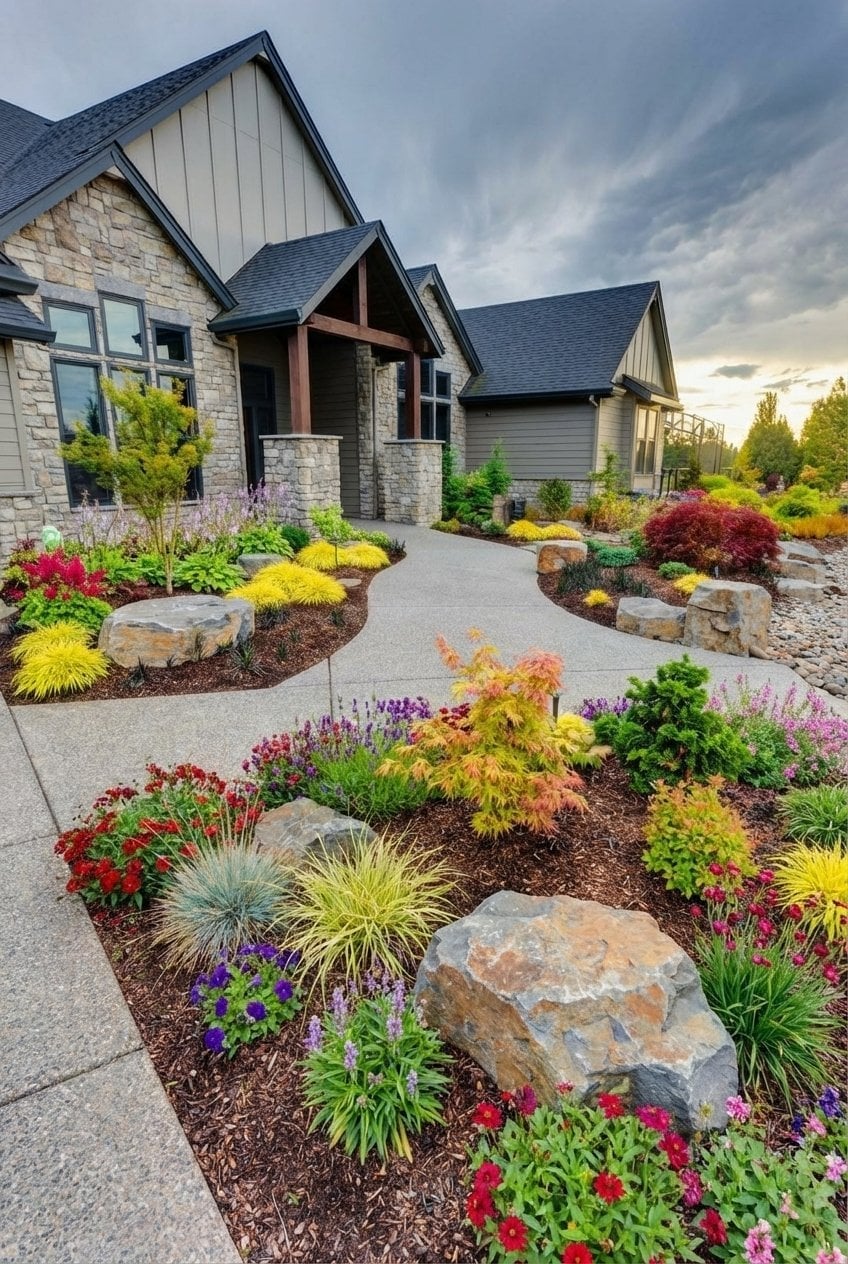
A winding concrete path through flower beds feels more relaxed than a straight walkway, but the palette here is anything but shy. The gray of the concrete path and the large rocks anchors the scheme, while the green, yellow, red, and purple of the flowering plants and ornamental trees do the work. An overcast sky mutes the daylight, so the vibrant color is the main event. The layout keeps the path clear, but the beds on either side are full and layered, with mulch keeping the soil in place. Limit the path to a single material and let the plants carry the color.
Ornate stone urn atop a manicured boxwood hedge
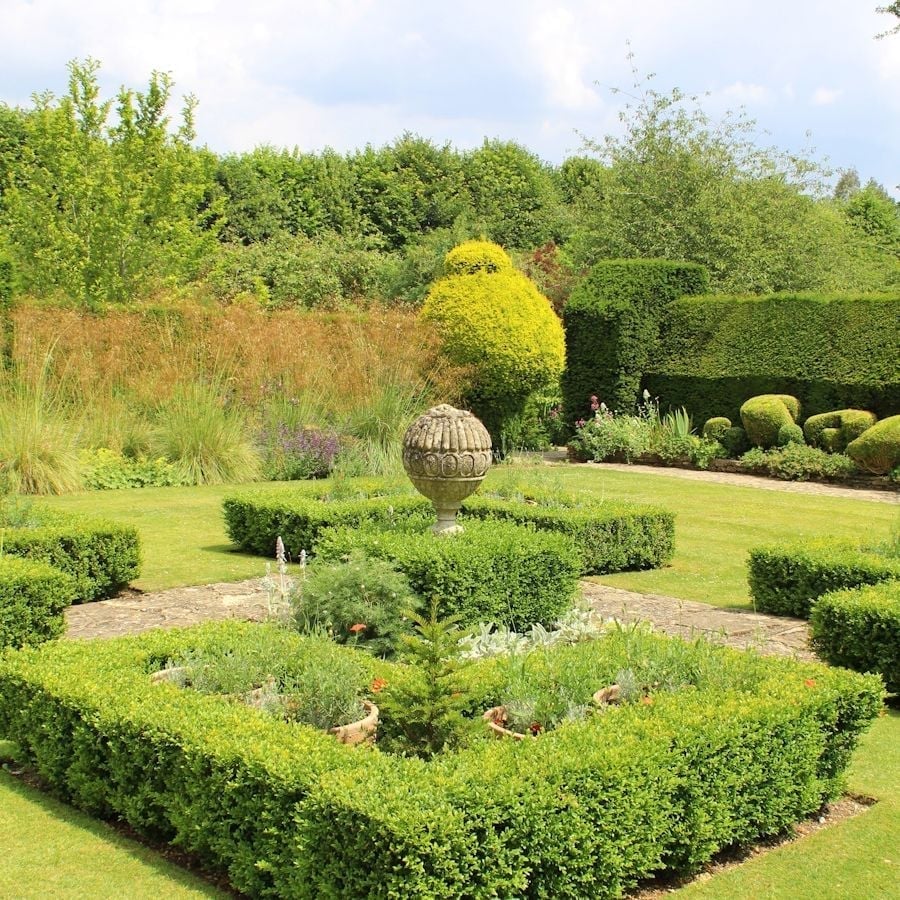
A single ornate stone urn draws the eye faster than a dozen small pots. Here, the urn sits centered on a manicured boxwood hedge, with the green of the hedge and the beige of the stone forming a simple contrast. The geometric beds around it are filled with grass and gravel, keeping the garden quiet so the urn is the feature. For a formal garden, the ratio is one strong material to one strong shape: the stone urn is the material, the clipped boxwood is the shape.
Curving path bordered by shrubs and ornamental grasses
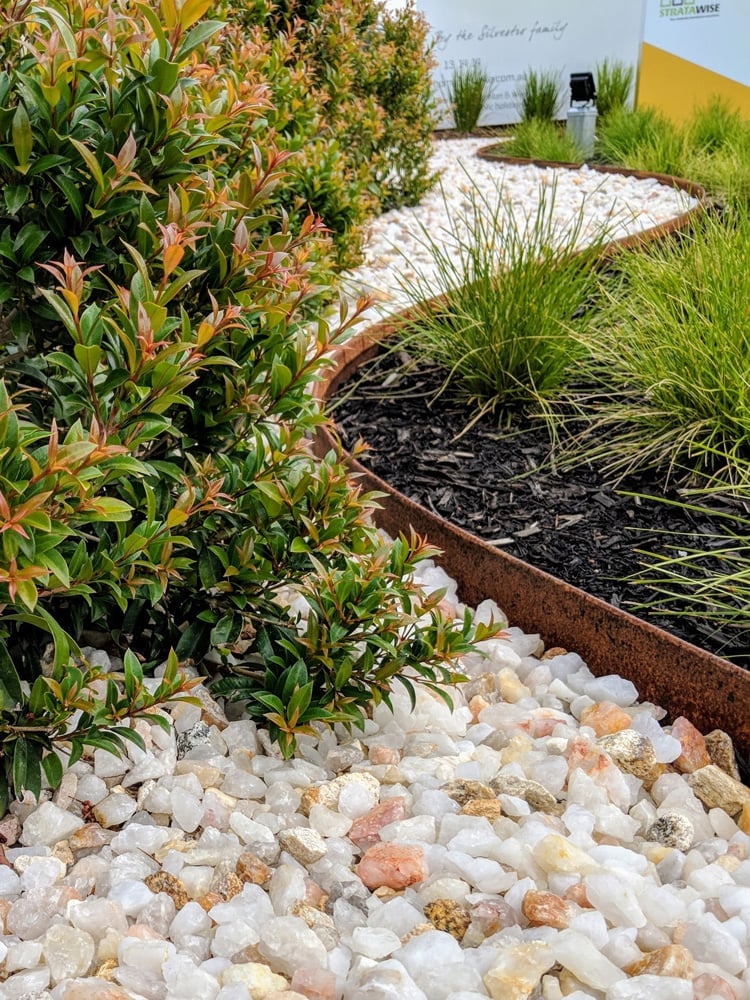
A curving path with a white and pinkish stone surface looks intentional when the border is kept crisp. The metal edging separates the stone from the dark brown mulch and the green, white, and orange of the shrubs and ornamental grasses. Solar lights along the edge mean the path is visible after dark without wiring. The layered planting keeps the view open from the street, but the metal edge stops the mulch from washing into the path during rain. For a lower-maintenance version, use larger stones and skip the solar lights.
Cottage garden charm with overgrown pergola and brick pathway
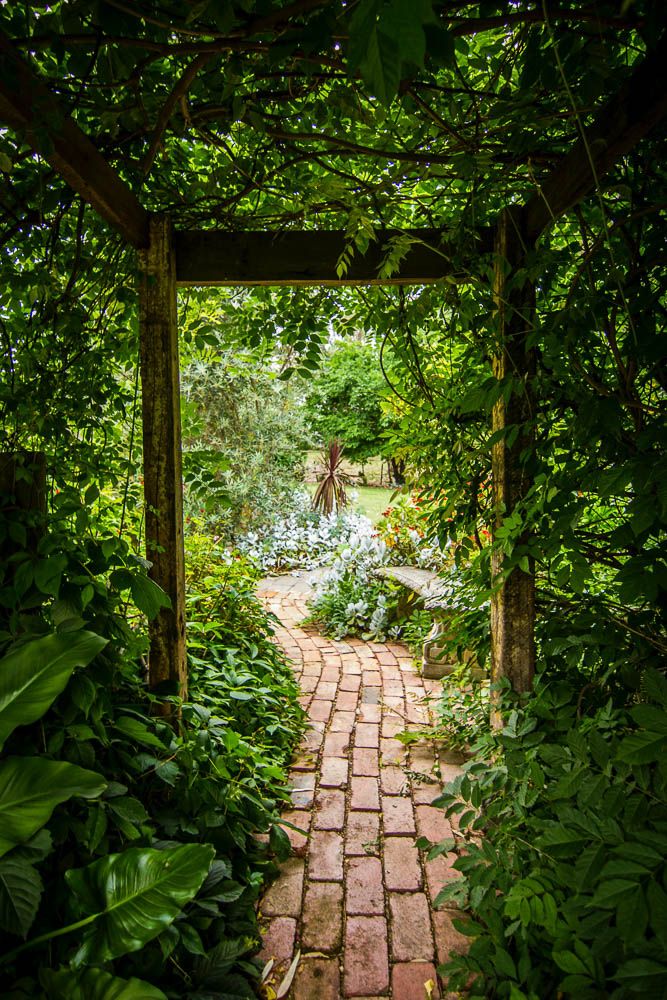
To create cottage garden charm, let the plants claim the structure. Here, the brick pathway curves under a wooden pergola that is nearly hidden by climbing vines and white flowers. A stone bench sits off the path, and the overgrown archway entrance feels like the garden grew around it, not like it was planned. The palette stays green, red brick, and white flowers, with no competing colors. For a similar feel without a permanent pergola, set a metal arch trellis in a large container and train a climbing rose or clematis over it.
Layered plantings lead towards mature trees and bamboo
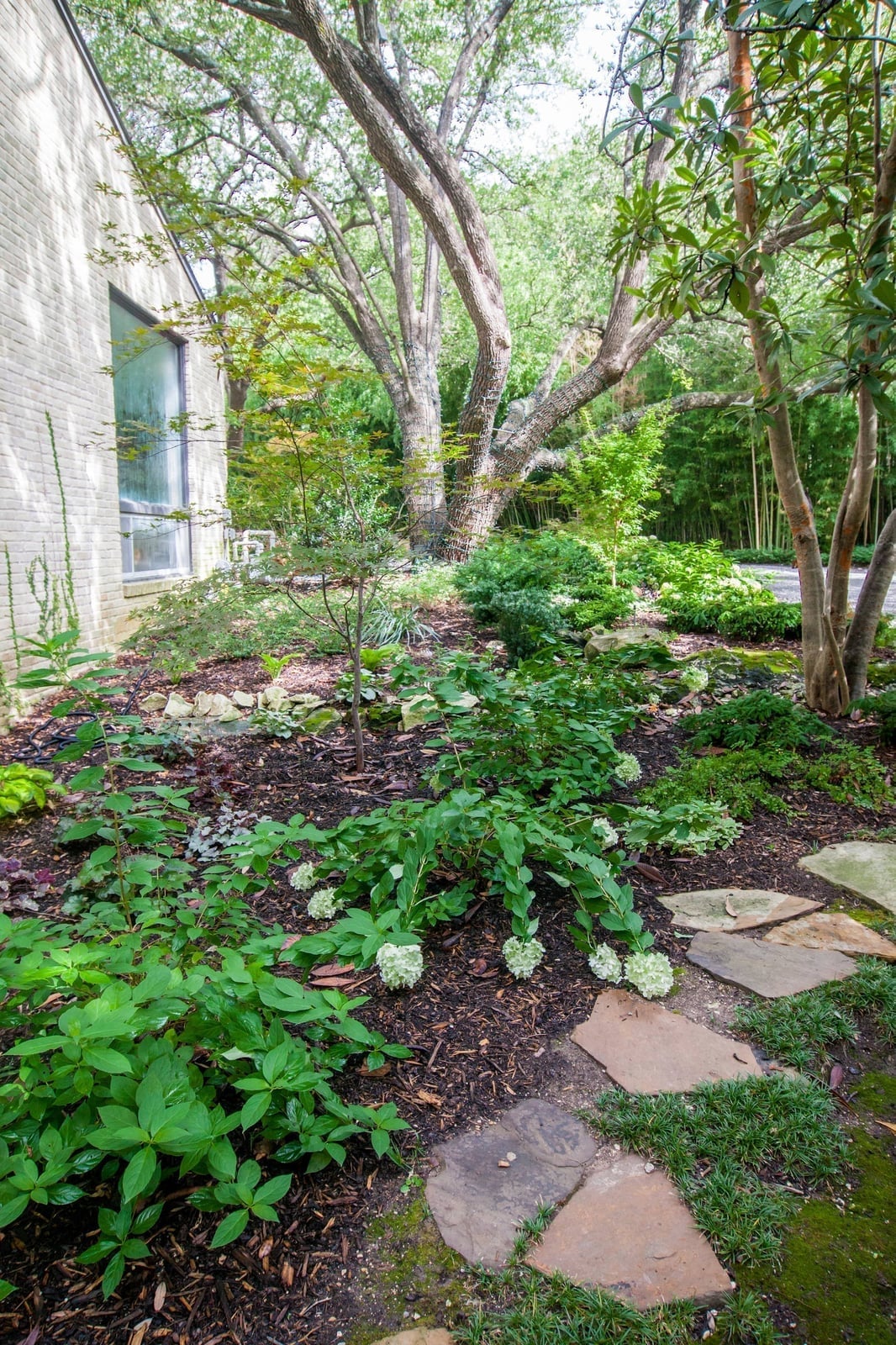
A winding path of stone pavers and brick disappears into a landscape where layers of hydrangeas, ornamental maple, and bamboo sit beneath mature trees with textured bark. The layout does the work here: low ground cover gives way to mid-height shrubs, then to the canopy above, so the eye travels naturally from the walkway upward. Mulch beds keep the soil moist and define each planting zone without hard edges. This kind of layered planting suits a yard that already has some shade, since the dappled light under the trees is exactly what hydrangeas and bamboo prefer.
Linear concrete stones lead through lawn and gravel
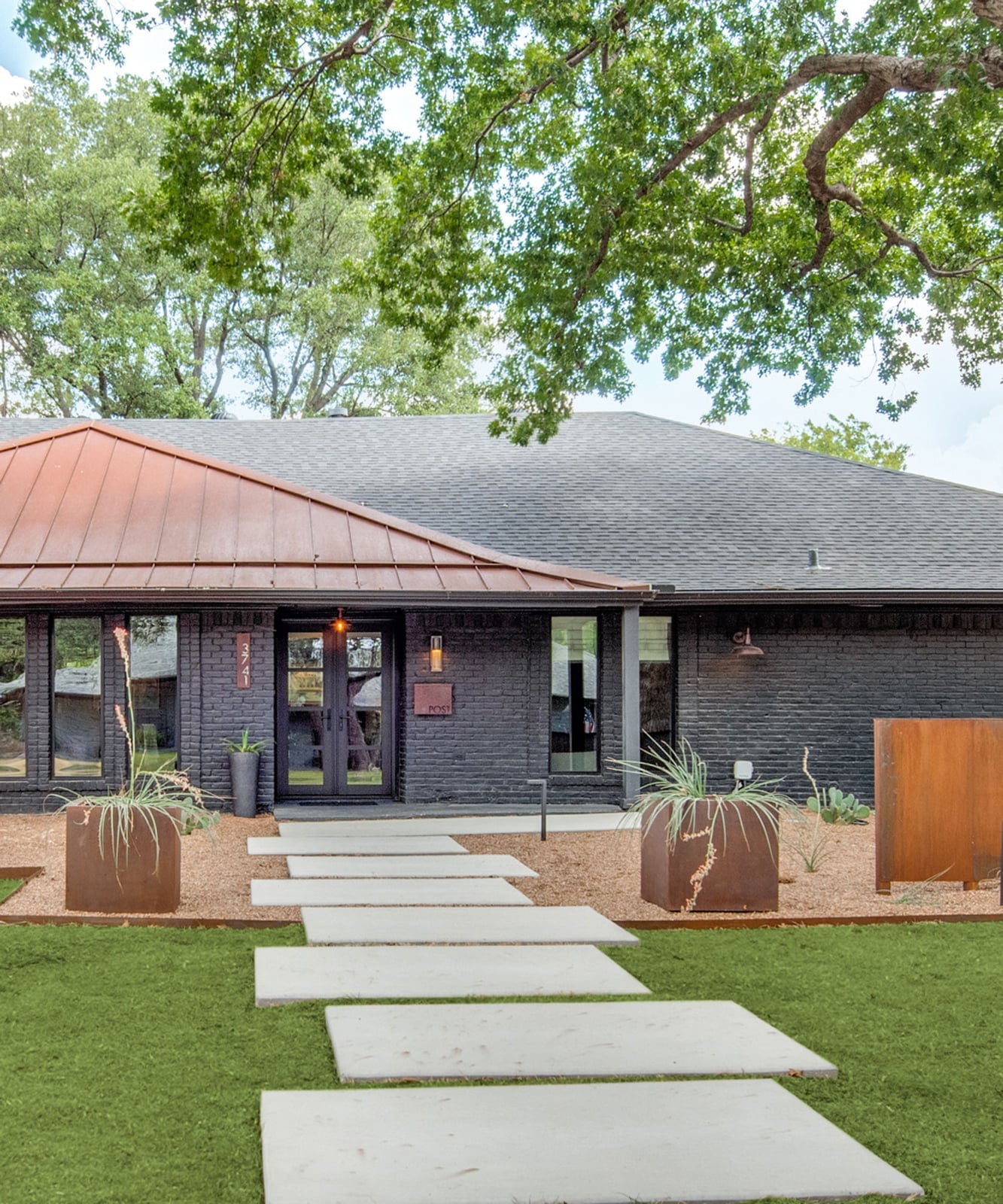
Keep the hardscape simple and let the materials contrast. Linear concrete stepping stones cut a straight line through a mix of lawn and dark gravel, bordered by a metal screen and large planters. The copper roof detail on the house picks up the warm tones in the brick, while black outdoor sconces and low pathway lights make the route usable after dark. For renters, this layout is a smart swap: concrete pavers sit on the ground without digging or pouring, and gravel can be raked back into place when it is time to move out. The metal edging keeps the gravel from migrating into the grass.
Curved walkway leads to circular patio fountain
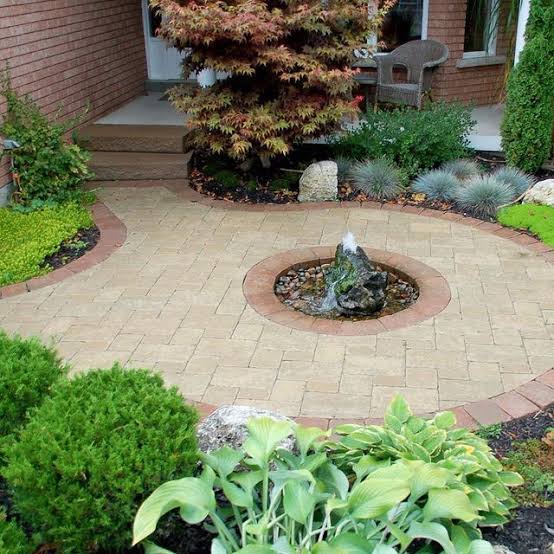
A straight path gets you to the door quickly, but a curved walkway invites you to slow down. Here, a gentle arc of pavers and brick leads to a circular patio centered on a small rock fountain. The fountain becomes the focal point without competing with the house, and the red foliage of the ornamental tree adds a seasonal pop against the tan and brick tones of the hardscape. Manicured shrubs frame the patio and keep the look tidy.
For anyone debating a front yard fountain, a recirculating model on a paver base is the most straightforward option. It needs a nearby outlet or an extension cord rated for outdoor use, and the water level should be checked weekly in summer. The sound of running water masks street noise, which is a bonus if the house sits close to the road.
White birdhouse and stone path create inviting atmosphere
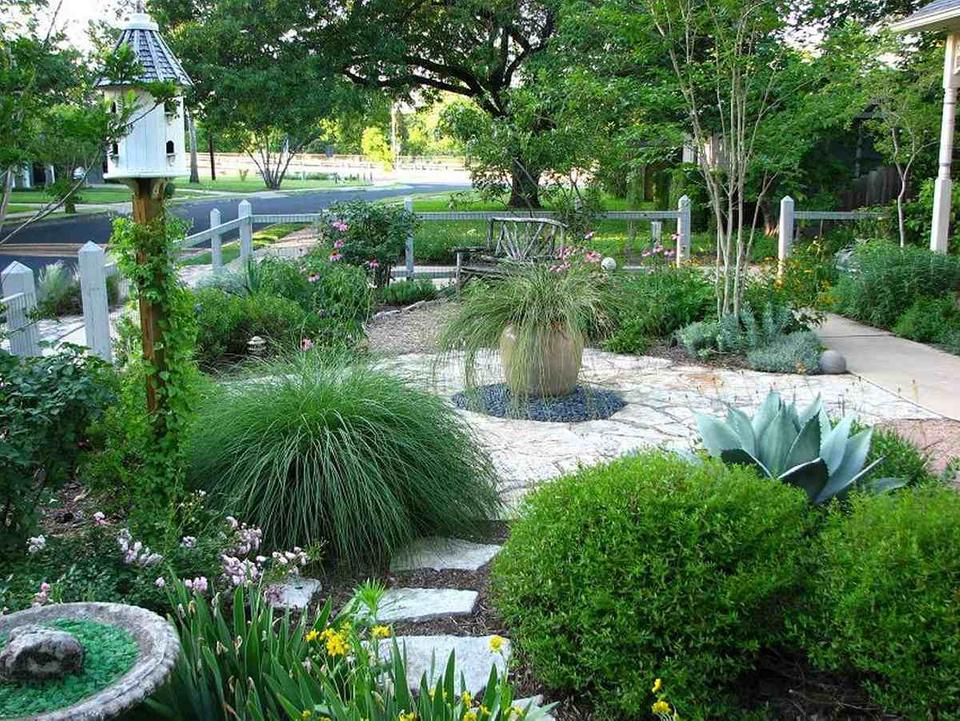
A white birdhouse on a wooden post stands at the turn of a winding stone path, surrounded by ornamental grass, a large planter with an agave, and pink blooms. The birdhouse adds a lived-in feel to a cottage garden. The stone pathway is wide enough for two people to walk side by side, and the gravel edges keep the path from getting muddy after rain. Choose a birdhouse with a removable roof so you can clean it out between nesting seasons, and set the post where you can see it from a window.
Traditional entrance with layered flowering bushes and stone steps
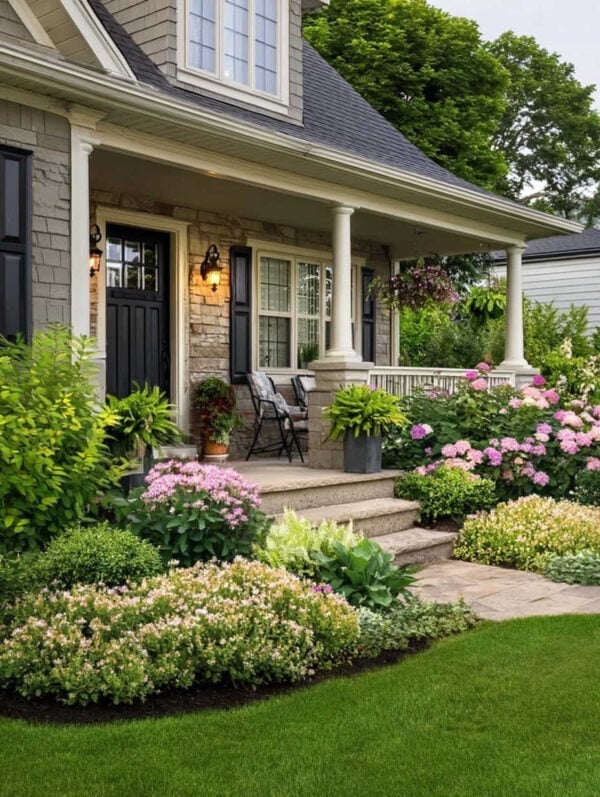
This entrance uses a simple palette: green foliage, pink and white blooms, gray stone, and warm wood porch columns. The stone steps rise in shallow risers, making the approach feel gradual. Flowering bushes are planted in layers along the pathway, with the tallest near the porch and shorter varieties spilling toward the walkway. Outdoor sconces on the columns cast warm light across the steps at dusk. The narrow range of greens and blush tones keeps the abundance of blooms from looking chaotic. For a traditional front yard, this ratio of green to flower gives the look its structure.
Stone facade with geometric planters and water feature
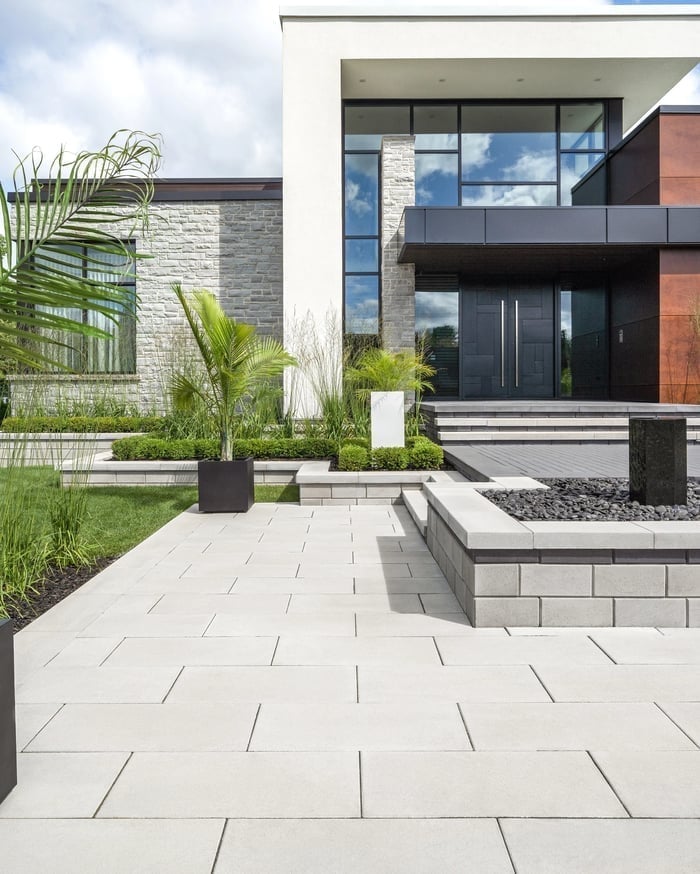
A modern entrance uses hardscape to set the rhythm before adding a single plant. This front yard anchors with a geometric stone facade and large double doors, then layers in concrete raised planters and a water feature that repeats those clean lines. The palette sticks to gray, white, black, green, and brown, so nothing competes with the stonework. A paved walkway leads past layered planting beds, keeping the layout spacious. The water feature adds sound and movement without breaking the minimal feel. For renters, swap a built-in water feature for a self-contained tabletop fountain on a concrete plinth. It gives the same sensory lift and can move with you.
Dark gravel path leads through vibrant dahlia beds
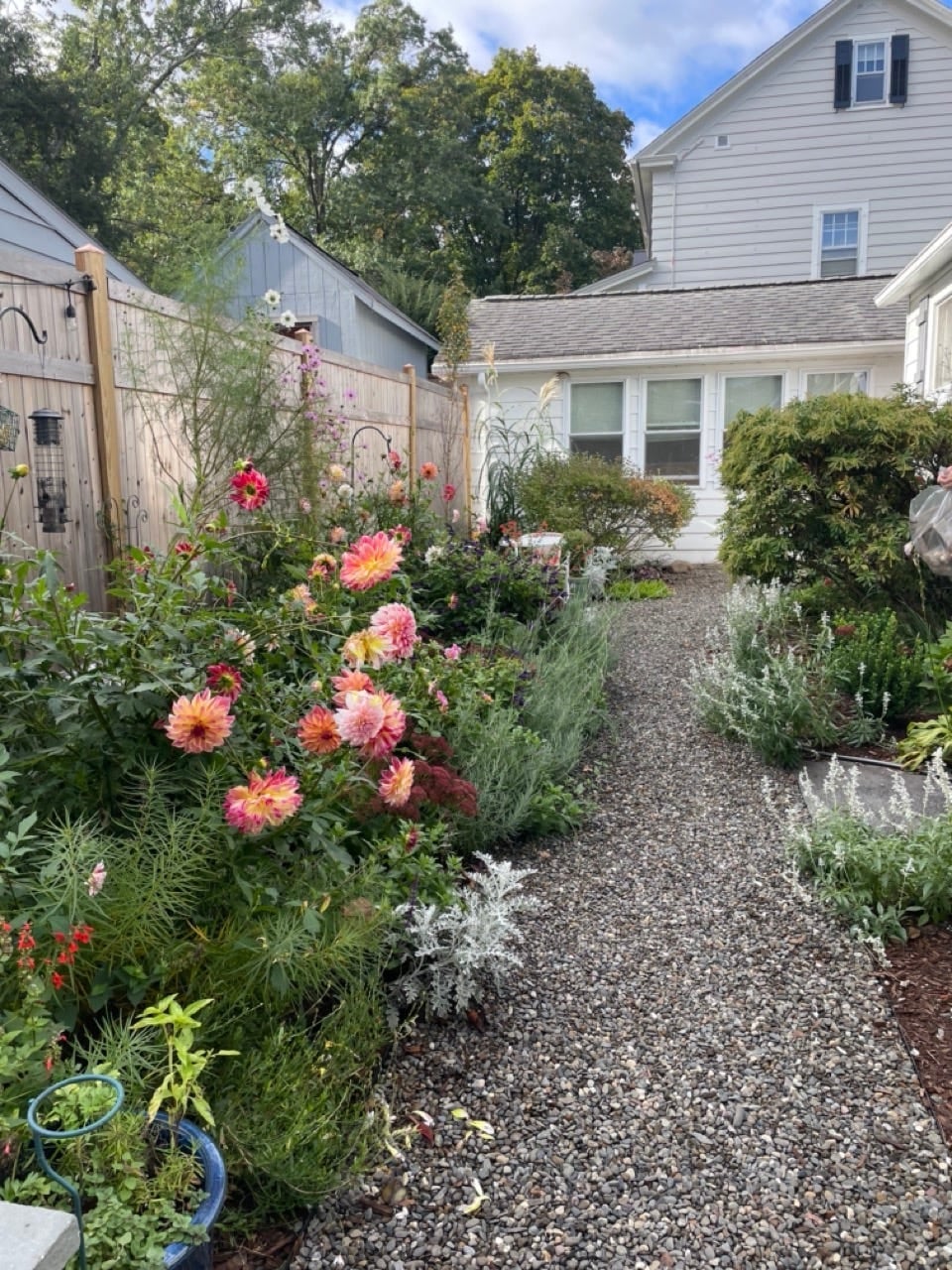
A narrow cottage front yard gains depth when a dark gravel path cuts through beds packed with dahlias in pink, orange, and yellow. Lavender, dusty miller, and ornamental grass add gray-green and white contrast, so the bright blooms do not feel chaotic. The gravel acts as a neutral base that lets the foliage take center stage. The palette ratio here is roughly three parts flower color to one part foliage, which keeps the garden lush without looking busy. If your yard gets full sun, check your USDA zone before planting dahlias. They need consistent water but reward with steady blooms through late summer.
Final Thoughts
A well-planned front yard balances curb appeal with everyday function. The common thread across these 22 designs is thoughtful layering: paths that guide the eye, plants that offer seasonal interest, and hardscaping that holds up to weather. Before you dig, check your USDA zone for plant survival, and consider how much time you want to spend on upkeep. Gravel and stone require less maintenance than lawns, while flowering beds need regular care. The best choice is the one that fits your lifestyle and makes you smile when you pull into the driveway.